
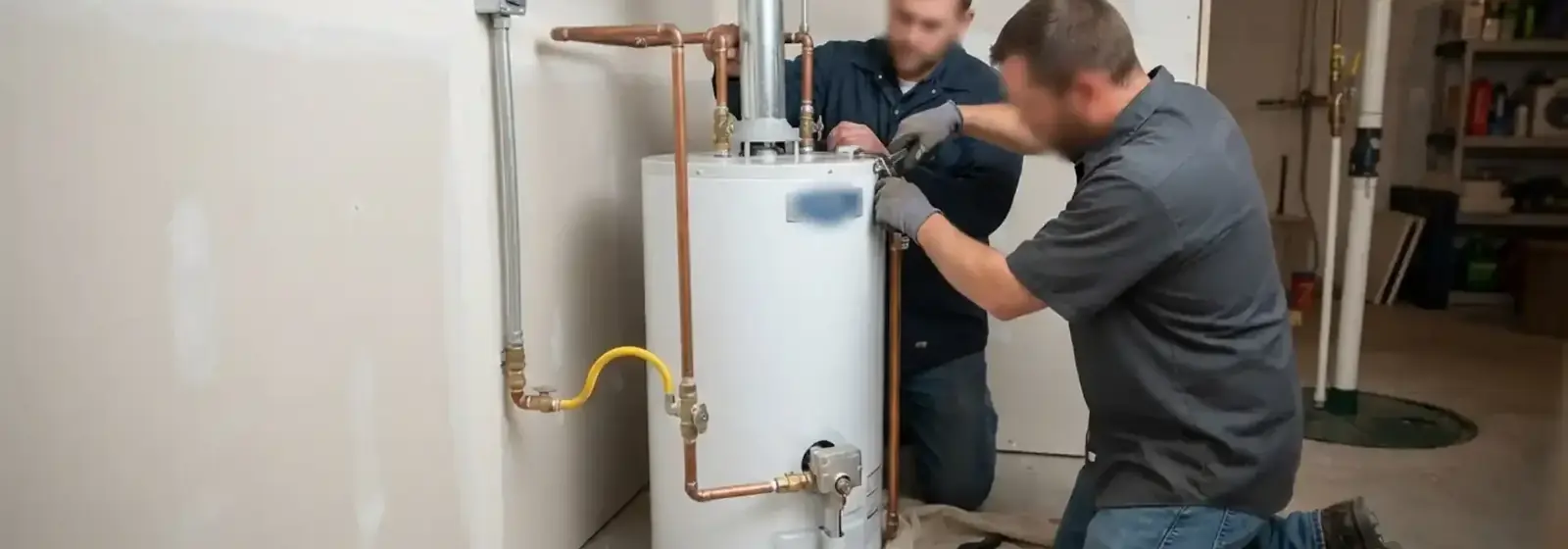
Emergency Water Heater Replacement in Rahway, NJ
When the tank has failed, we size a new heater, haul the old one out and hook up the new one properly. Same-day when available, with a clear price first.
Tank failed: what to do before we arrive
If your tank is leaking or you have no hot water at all, call our emergency line, which is open 24/7, for water heater replacement in Rahway, NJ. Close the cold water valve above the tank, turn off the breaker or set the gas control to off, and keep people out of the standing water. Our water heater repair page covers parts that can be saved, but a rusted-through tank cannot.
Water heater replacement means removing the old tank and installing a new unit, with new connections, venting, relief valve and discharge piping set up as the code and the maker's instructions require. A good replacement is more than a swap. It also corrects the things that killed the first heater.
Leave the building and do not flip switches. Call 911 and Elizabethtown Gas at 1-800-492-4009 from outside, since that is the gas utility in Rahway. We cannot promise response times on gas leaks, and no heater is worth staying in a building that smells of gas.
No hot water since last night?
Call (732) 466-1098. We will tell you what a replacement involves and give a clear price before work starts.
When replacement beats repair
Tank heaters commonly last 8 to 12 years, but water quality, sediment and care change that a lot. The real test is whether the tank is leaking or corroded, and that is why we look at the base, the fittings and the sediment before we say anything.
| What we find | Better path | Why |
|---|---|---|
| Water coming from the tank body or the base | Replace | The steel has rusted through, so the leak will not stay small |
| Rusty, brown hot water and heavy sediment | Usually replace | The tank interior is breaking down |
| Failed element or thermostat on a younger tank | Repair | The tank is sound and the part is the problem |
| Tank past 12 years with repeated repairs | Often replace | The next failure is likely soon |
| Dripping T&P valve, tank otherwise dry | Repair first | Test pressure and expansion before spending on a tank |
We diagnose first, then price either path where both make sense. Our repair page covers the fixes.
How we size a replacement
Sizing matters more than most buyers expect. A tank that is too small runs out during the second shower, and one that is too large keeps extra water hot all day. We look at three things: how many people live in the home, how many fixtures run at the same time and the unit's first-hour rating (FHR).
FHR is the number to compare. It tells you how much hot water the heater can deliver during its first hour of heavy use, which is when your household feels it most. Tank capacity alone can mislead, because two 50 gallon tanks can have different FHR numbers depending on the burner or elements.
| Household | Typical starting point | Other things that push the size up |
|---|---|---|
| 1 to 2 people | Smaller tank, often 30 to 40 gallons | Large soaking tub |
| 3 to 4 people | Mid-size tank, often 40 to 50 gallons | Back-to-back morning showers |
| 5 or more people | Larger tank or high-recovery unit | Dishwasher and laundry running at once |
Those are starting points, not rules. The space matters too: older Rahway homes often have a heater tucked into a basement corner, and a taller or wider tank has to fit through a stairway and sit within the clearances on its label. We measure before we promise a model.
What happens on replacement day
Shut down and drain
We close the supply, kill the fuel or power, and drain the tank to a floor drain or a hose we run outside. A clear drain helps, so check yours.
Remove the old unit
We disconnect the plumbing, the vent and the gas or electrical connection, then carry the tank out. Basement stairs are usually the hard part.
Set and connect the new tank
We set the heater level, install new flexible connectors or piping, a new T&P valve and a discharge pipe, and check the vent.
Fill, test and explain
We fill the tank, purge air, check for leaks, light or power the unit and set the temperature. We show you the shutoffs.
Venting, expansion tank and T&P discharge
Three details decide whether the new heater lasts. On gas units the vent must pitch upward, connect tightly and pull exhaust out of the building. We look for rust, gaps and backdrafting, and we tell you if a flue repair is needed before we light the new burner.
The expansion tank absorbs the extra volume of water as it heats in a closed system. Without one, pressure spikes can open the relief valve or shorten the life of the tank. If your home has a backflow preventer or pressure-reducing valve on the service line, the system is likely closed, and we test pressure to decide.
The T&P discharge pipe must run full size, with no cap, thread or valve on its end, and terminate where a leak is visible and safe. A relief valve is the last protection against a tank overpressure event, so we do not shortcut it.
Ready to price a replacement?
Call the 24/7 line at (732) 466-1098 and tell us your fuel, tank size and location.
Same-day replacement and after-hours calls
We offer same-day appointments when available. Whether we can swap a heater the same day depends on whether a matching unit is on hand, how the venting looks and whether the work needs a permit conversation first. We never promise a clock time, and we will tell you straight if the answer is tomorrow.
While you wait, a house without hot water is livable for a night. Boil water for dishes, take a quick cold wash and make sure the old tank is isolated. If a burst tank is flooding a finished basement, call us right away and, if the water is spreading, see our burst pipe repair page for how to cut it off.
Gas to heat pump: should you switch?
A hybrid heat pump water heater moves heat from the surrounding air into the tank, so it uses far less electricity than a standard electric element. It needs room for air flow, a condensate drain and an electrical circuit. In a cramped Rahway basement the air flow and drain are the usual challenges.
Switching from gas takes more than swapping a tank. The gas line has to be capped safely, the old vent may be removed and an electrician may need to add a circuit. We handle the plumbing side, and the water heater installation page explains the full picture. If a tankless unit appeals, our tankless water heater page gives the honest trade-offs.
Licensed work and the Rahway Division of Building
New Jersey requires water heater installation to be done by a licensed master plumber, an authorized plumbing contractor or their supervised employees. That rule is in the state plumbing board's regulations, and you can check any plumber through the Division of Consumer Affairs license verification. Be wary of anyone who cannot answer that.
Permit rules vary, so ask the Rahway Division of Building at One City Hall Plaza whether your job needs one. Water heaters are not on the state list of ordinary plumbing maintenance. Also remember that Rahway requires a CACO inspection when a home is sold or tenants change, so an unpermitted or leaking heater can come up there.
Basement tanks, access and the old unit
With about 64.9 percent of Rahway homes built before 1980, many replacements happen in a basement with a narrow stairway and sometimes a low ceiling. Tell us about the stairs when you call. A cramped path can mean a longer job or a model chosen partly by what fits.
If your basement takes on water in storms, tell us, because a new heater should sit on a stand or pad and the sump situation may need attention. Our sump pump repair page covers that side.
What affects the cost of a replacement
We state a clear price before work starts. Want your real number? Call (732) 466-1098 and describe the tank.
Manufacturer coverage on new tanks varies by model and by who installs the unit. Read the paperwork that comes with the heater and keep the receipt. We do not make coverage promises on a manufacturer's behalf.
Homeowner policies commonly cover sudden water damage from a failed tank but not gradual leaks or the age of the heater itself. Ask your insurer, and take photos before the old unit leaves. If you are in Clark, our Clark service page has details on that area.
A replacement unit is installed to the National Standard Plumbing Code as adopted in New Jersey, including relief valve discharge and venting. If your old install was not up to that standard, we say so plainly.
Water heater replacement questions
Yes. Our line is open 24/7, and a burst tank at night is a call we take seriously. Same-day replacement depends on the unit and the parts we can source, so we do not promise a time. We do tell you what to shut off and what can safely wait until morning.
A straightforward swap of the same type in the same spot is often a half day of work, including draining, removal, hookup, filling and testing. Venting changes, a fuel switch or a tight basement stairway can stretch that. We give you a realistic window when we see the space.
Size depends on how many people use hot water, how many fixtures run at once and the unit's first-hour rating, which is how much hot water it can deliver in its first hour. A bigger tank is not always better, since it costs more to keep hot. We help you match the unit to how you actually live.
Water heaters are not on the state list of ordinary plumbing maintenance, so ask the Rahway Division of Building at One City Hall Plaza whether a permit applies to your job. Permit rules vary, so ask before work starts. We can describe the work so the office can answer correctly.
In New Jersey, water heater installation is plumbing work that must be done by a licensed master plumber, an authorized plumbing contractor or employees working under a master plumber. You can check any plumber's license through the Division of Consumer Affairs. A do-it-yourself install can also cause trouble with an insurer after a loss.
It can make sense, but it changes the install. A heat pump unit needs electrical capacity, room for air flow and a condensate drain. We cover the plumbing side and bring in an electrician if a new circuit is needed. The installation page has the detail.
We drain it, disconnect it and carry it out as part of the job. You do not have to find a way to dispose of it. If you want to keep any parts, tell us before we start.