
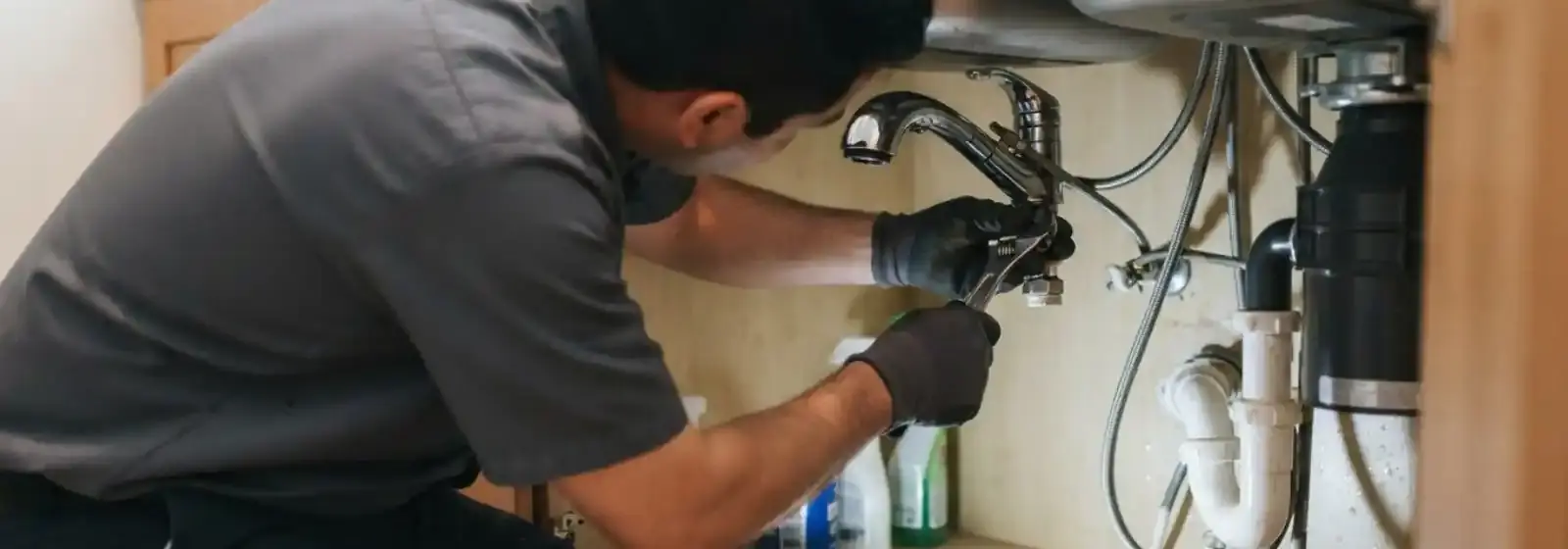
Emergency Faucet Repair in Rahway, NJ
Faucet that will not shut off, a sink supply valve spraying, or a hose bib split by frost in Rahway, NJ? We stop the water, find the failed part and price the repair before we start.
Faucet or valve will not shut off: do this first
A faucet that runs after you close it, or a valve that sprays when touched, is wasting water in Rahway, NJ by the minute, and our emergency line (732) 466-1098 is open 24/7. First look under the sink for the small oval-handled valves on the two supply lines and turn each clockwise. Set a bucket under the leak.
If those valves will not close or leak at the stem, go to the main shutoff, usually near the water meter in the basement, and turn it fully clockwise. Open the lowest faucet in the house to drain pressure. Then call, tell us which fixture is the source, and we will say what to expect.
Do not pry at a seized valve with a wrench. Old valves in Rahway houses, many built before 1960, can crack at the stem or the nut, and a valve that held for decades can fail in one turn.
Broken or burst supply valves under the sink
The shutoff valve under a sink is the cheapest part in the plumbing system and the one that floods kitchens. Brass multi-turn valves seize with mineral deposit, quarter-turn ball valves last longer, and braided supply lines eventually corrode inside the braid. A bulge, rust bloom or dripping nut means replace it now.
Here is how we replace one. We close the main, drain the line, cut off the old valve and sweat or compression-fit a new one, then connect new supply lines and test under full pressure. If the stub pipe from the wall is corroded, we replace that section too, since a new valve on bad pipe fails just as fast.
If a valve has already burst and soaked the cabinet, the water may have traveled down the wall or into the floor below. When the damage is more than one cabinet, treat it like a burst pipe and keep the main off until we arrive.
Why faucets drip and what actually fixes them
Inside every faucet is a part that stops the water: a compression washer, a ceramic disc cartridge, a ball assembly or a rubber-seated cartridge. When it wears, water seeps past and the faucet drips from the spout or leaks around the handle. A leak at the base usually points to O-rings, which are quick to replace.
| Faucet type | How it fails | Usual repair |
|---|---|---|
| Two-handle compression | Worn washer or scored seat | New washer, reface or replace the seat |
| Single-handle cartridge | Worn cartridge or O-rings | Replace cartridge and O-rings |
| Ball-type | Worn seats and springs | Replacement kit for ball and seats |
| Ceramic disc | Cracked disc or debris | Clean or replace the disc cylinder |
| Pull-down kitchen | Failed hose or diverter | Replace hose, diverter or the faucet |
| Any type, handle leak | Dry or cut O-ring | New O-rings and packing |
Mineral scale on the aerator cuts flow and is not a leak, so soak the aerator in vinegar before blaming the faucet. To learn what is in your water, test your tap or ask Veolia Water Rahway for its annual water quality report.
Valve spraying or faucet running wild?
Shut the main, then call the 24/7 line. We give the price before any work starts.
Shower valves, showerheads and tub faucets
A showerhead that drips after the shower is off often has a worn diverter or a leaking cartridge behind the wall plate. Those parts are inside the wall, so the repair starts at the trim, and a few models need the wall opened if no access panel exists. A dripping tub spout points to the diverter or the same cartridge.
Hot water that fades or swings between hot and cold usually means a worn pressure-balancing cartridge, though a failing heater can mimic the same symptom. If only the shower acts up while sinks stay steady, the valve is the suspect. When every hot tap runs weak, see water heater repair.
Slow drips behind a shower wall can rot framing before they show. A stain on the ceiling below the bathroom is the early warning, and leak detection pinpoints the source without tearing out tile.
Outdoor spigots, frost-free hose bibs and winterizing
A hose bib is a short pipe through the wall with a handle outside. A frost-free model has a long barrel so the shutoff sits inside the warm wall, but it only drains if the barrel tilts slightly downhill and nothing is attached to the outlet. A hose left on through the first freeze traps water in the barrel, and that ice splits the pipe, often inside the wall.
Remove hoses
Take off every hose and splitter before the first freeze, including soaker hoses and spray heads.
Close the inside valve
If your hose bib has an interior stop, close it, then open the outside spigot to drain the line.
Leave it open
Leave the outdoor handle open through winter so any trapped water has room to expand.
Check in spring
Open the spigot slowly. Watch the wall and ceiling below for dampness when it first runs.
A hose bib that sprays from the handle or drips from the wall side after the winter needs repair. We replace the spigot, repair the split section, and install a new frost-free bib if the old one lacks a slope or a stop. Wall leaks that show up after thaw sometimes need water line repair if the break is beyond the wall.
Laundry sinks, utility sinks and behind-washer valves
Utility sinks collect old faucets, rubber hoses and lines running into the basement ceiling. The weak points are the compression stems, the slip joints on the trap, and the washer valves behind the machine. Rubber washer hoses bulge and burst, so we replace them with braided stainless hoses.
Washer shutoffs deserve a monthly check. If the handle is stiff, it is seizing, and if it weeps at the stem, the packing is finished. Replace the valves as a pair with new hoses, and check that the drain standpipe is the right height so the machine does not siphon or overflow.
Repair or replace the faucet?
Repair makes sense when
- The body is solid and the finish is intact
- Parts for the model are available
- The problem is a drip or a loose handle
- A cartridge or seat swap restores it
Replace makes sense when
- The finish is peeling or the body is corroded
- Parts are discontinued or hard to find
- Repairs have repeated on the same fixture
- You are updating the sink or tub anyway
We bring common cartridges and washers, but exact parts depend on the model. A photo of the brand name stamped on the faucet saves a trip. If a part is not on the truck, we say so before leaving and tell you what the second visit involves.
Permits and the Rahway Division of Building
Under New Jersey rules, faucet and valve repair counts as ordinary plumbing maintenance, along with traps, stoppages and like-for-like fixture swaps with no piping change. If you are unsure whether your job qualifies, ask the Rahway Division of Building, which is at One City Hall Plaza. In Clark, permit rules vary, so contact the Clark Township construction office before work starts. See plumbing in Clark for our Clark service.
What affects the cost of faucet repair
Want your real number? Call (732) 466-1098 and tell us the fixture, the brand if you know it, and what it does. Homeowner policies often cover a sudden burst but not slow drips or wear, so ask your insurer before you file.
Questions about faucet repair
Yes. A faucet that will not shut off or a supply valve that sprays under a sink is an emergency, so the line is open 24/7 and same-day appointments are offered when available. Close the main valve first if the fixture shutoff fails, then call and tell us what the fixture is doing.
Yes. A drip that fills a cup in an hour wastes thousands of gallons over a year, stains the basin, and usually means a seat or cartridge that will fail completely. The repair is small if you do it before the part scores the metal.
If the body is intact and parts are available, a cartridge, washer or seat usually restores it. If the finish is flaking, the body is corroded, or repair parts are discontinued, a new faucet is the better spend. We tell you which, with the price of each.
A hose left attached through a freeze traps water in the pipe, which then freezes and splits the copper behind the wall, often where you cannot see it. The leak appears when the weather warms and the spigot is turned on. A frost-free hose bib reduces the risk only if the hose is removed and the barrel can drain.
Close the main water valve for the building, then call. Do not force a seized valve or crank it with pliers, since the stem can snap and the leak gets worse.
Yes. Washer valves, supply hoses and the drain standpipe are all part of what we service. Replace rubber hoses with braided ones, and shut the valves off when you leave for a trip.
Under New Jersey rules, faucet and valve repair counts as ordinary plumbing maintenance. If you are unsure whether your job qualifies, ask the Rahway Division of Building before work starts.