
Plumbing Installation in Rahway, NJ
New fixtures, remodel plumbing, basement bathrooms, gas lines and water treatment, planned with you and priced before work starts. Licensed plumbers handle the connections.
Plumbing installation in Rahway, NJ: planned work done right
Plumbing installation covers adding, moving or replacing fixtures, supply lines, drains, gas piping and water treatment. In Rahway, NJ, that often means a bathroom or kitchen remodel, a finished basement or an upgrade in a house that is decades old. The work is planned, so the details matter more than speed.
Our licensed plumbers explain what the job involves, what other trades must do and what it will cost before work starts. If something goes beyond plumbing, such as electrical or structural work, we say so up front. We offer same-day appointments when the schedule allows for urgent installs, but most projects are scheduled around your plans.
Fixtures, remodels and new lines
Replacing a faucet or toilet in the same location is straightforward. Moving fixtures, adding a second bathroom or relocating a kitchen means new supply and drain lines, and new lines affect venting, slope and access. Rahway has many older homes, with a median build year of 1962 (Census ACS), so tie-ins to existing pipe often reveal galvanized or aged copper that is better replaced than extended.
For major remodels, plumbing rough-in comes before walls close and tile goes in. That timing makes the plumber a key part of the schedule. If your pipes look worn, ask us about repiping while walls are open.
Basement bathrooms: ejector and upflush options
A basement bathroom is possible in many homes, but the drain is the main problem. If the basement floor sits above the main drain line, gravity can carry waste away. If it sits below, a sewage ejector pump or an upflush toilet system lifts waste to the drain.
Each option has trade-offs. An ejector pit needs a sealed lid, a vent and a power supply, and the pump needs service over time. An upflush unit avoids cutting the slab, but it handles fewer fixtures and has its own maintenance needs.
Rahway has flood-prone areas along the Rahway River, so a basement bathroom needs careful planning for backflow and power loss. Ask us how backwater valves, alarms and battery backups would fit, and consider sump pump issues in the same basement. The city's code keeps clean water out of the sanitary sewer, so ask the city engineer before choosing a discharge point for groundwater.
Planning a bathroom or kitchen?
Call and describe the layout. We will tell you what plumbing it needs and what other trades will be involved.
Gas line work: safety comes first
Leave the building right now. Do not touch light switches or use a phone inside. From outside, call 911 and the Elizabethtown Gas emergency leak line at 1-800-492-4009. Call a plumber only after the utility says it is safe.
Gas piping serves ranges, dryers, boilers, water heaters and outdoor grills. Installing or extending a gas line is licensed work, and permits and inspections usually apply. Permit rules vary, so ask the Rahway Division of Building before work starts.
Rahway's heating fuel is mostly utility gas, at 70.8 percent of homes (Census ACS), so gas appliance work is common here. We do not promise response times for gas emergencies, and gas utility work, such as meter or service line repairs, belongs to Elizabethtown Gas. For gas-fired heating, see our boiler repair page.
Water softener and filtration installation
Softeners and filters change how water behaves in a home. New Jersey licensing treats water softener installation as plumbing work, so it must be done by a licensed master plumber, an authorized plumbing contractor, or employees under a master plumber's supervision.
Before buying equipment, find out what is in your water. Test your tap, or ask Veolia Water Rahway for its water quality report. We do not state hardness figures because they are not verified, and the right system depends on results, not on a sales pitch.
A proper installation includes a bypass valve, a drain connection with an air gap, an electrical outlet nearby and space for salt or filter changes. Filters should list NSF/ANSI standards for the contaminants you care about. Ask us what you need and what service will be required.
Low water pressure fixes
If you install new fixtures and pressure still feels weak, the cause may not be the fixtures. Corroded galvanized pipe, a failing regulator or a leak on the service line can all cut flow. Check our water line repair page for the full list of causes and checks.
For a quick check, screw a pressure gauge onto a hose spigot. If the number is low, the problem is upstream of the new work. If it is normal, the fixture or its shutoff may be the bottleneck.
New construction and additions
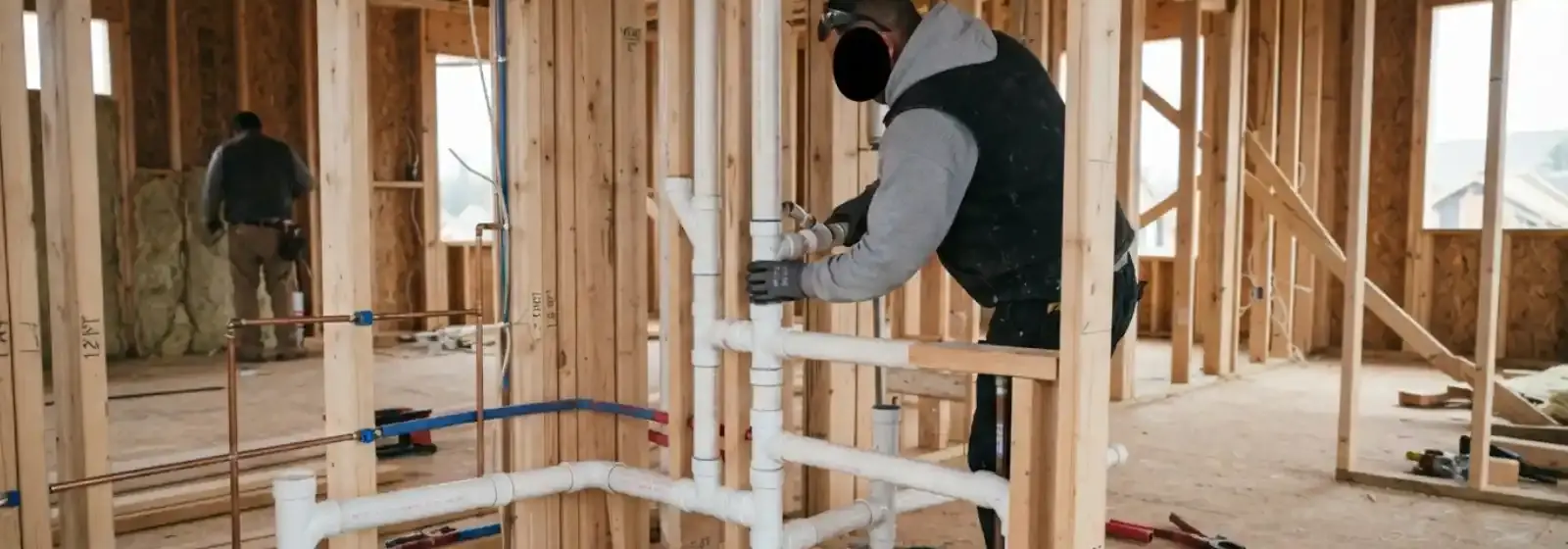
Rough-in is the first stage, with drains, vents and supply lines placed inside walls and under floors before inspection. Finish work follows, with fixtures set after walls and flooring are done. Rough-in must match the plans, so changes made after walls close can be expensive.
Adding lines to an existing home means connecting to current supply and drain pipes. We check what is there before promising a layout. A line that looks simple may need venting or slope changes to work correctly.
What to plan for each type of install
| Install type | What to plan for | Other trades involved |
|---|---|---|
| Fixture swap in the same spot | Matching shutoffs, supply lines and drain connections | Usually none |
| Bathroom remodel | Rough-in timing, venting, new shutoffs and tile schedule | Carpenter, tile setter, electrician |
| Kitchen remodel | Sink, dishwasher and disposal connections, gas for a range | Cabinet installer, electrician |
| Basement bathroom | Drain depth, ejector or upflush, vent route, backflow protection | Electrician, framer, drywall |
| Gas line addition | Permit, pressure test, appliance connection, shutoffs | Gas utility for service-side work |
| Water softener or filter | Test results, drain and bypass, power outlet, salt access | Electrician for outlet if needed |
| Additions and new construction | Rough-in plans, inspection stages, utility connections | General contractor, electrician, HVAC |
What we do not handle
Plumbing installation involves other trades. We do not do electrical work, structural framing, foundation repair, tile or drywall finishing, or gas utility work. We coordinate with those trades and tell you what must happen before and after our visit.
Ask what any quote includes. Some contractors include opening and patching walls, and some do not. Clear scope avoids disputes later.
Permits and licensing
New Jersey requires plumbing work to be done by a licensed master plumber, an authorized plumbing contractor, or employees under a master plumber's supervision. Ordinary maintenance such as like-for-like fixture swaps with no piping change generally needs no permit. Water heaters, sump pumps and boilers are not on that maintenance list, so ask the Rahway Division of Building whether a permit applies. Verify any plumber through the Division of Consumer Affairs.
What affects the cost of installation
Want your real number? Call (732) 466-1098 and describe the project. We also serve Clark, where 71.6 percent of homes were built before 1970 (Census ACS), so our plumber in Clark page covers that area.
Ready to plan the job?
Call the line, describe the project and we will lay out the steps.
New fixtures, supply lines and drains are installed to New Jersey's plumbing subcode, which adopts the National Standard Plumbing Code. Ask the Division of Building whether your project needs a permit.
Plumbing installation questions answered
We install fixtures such as sinks, faucets, toilets, tubs and showers, supply and drain lines for remodels and additions, basement bathrooms, gas piping for appliances, water softeners and filtration, and rough-in for new construction. For water heaters, see our dedicated water heater installation page.
It depends on the work. Ordinary maintenance such as a like-for-like fixture swap with no piping change generally needs no permit, but adding or moving lines, gas work and other changes can. Permit rules vary, so ask the Rahway Division of Building before work starts.
New Jersey treats water softener installation as plumbing work that must be done by a licensed master plumber, an authorized plumbing contractor, or employees under a master plumber's supervision. Ask any installer for their license and verify it through the Division of Consumer Affairs.
We do not state hardness figures because they are not verified. Test your tap, or ask Veolia Water Rahway for its water quality report, before buying equipment. If the result shows a hardness issue, we can discuss options.
Often yes, but drain location is the main question. If the basement floor is below the sewer line, a sewage ejector or upflush system may be needed. We assess the layout, then explain the options, including what electrical and structural work other trades must do.
Leave the building right away. Do not touch switches or use a phone inside. Call 911 and the Elizabethtown Gas emergency leak line at 1-800-492-4009 from outside, and call a plumber only after the utility says it is safe.
No. Plumbing installations often need electricians, carpenters, tile setters or drywall finishers, and we coordinate around them. We tell you early what each trade must complete so the schedule works.