
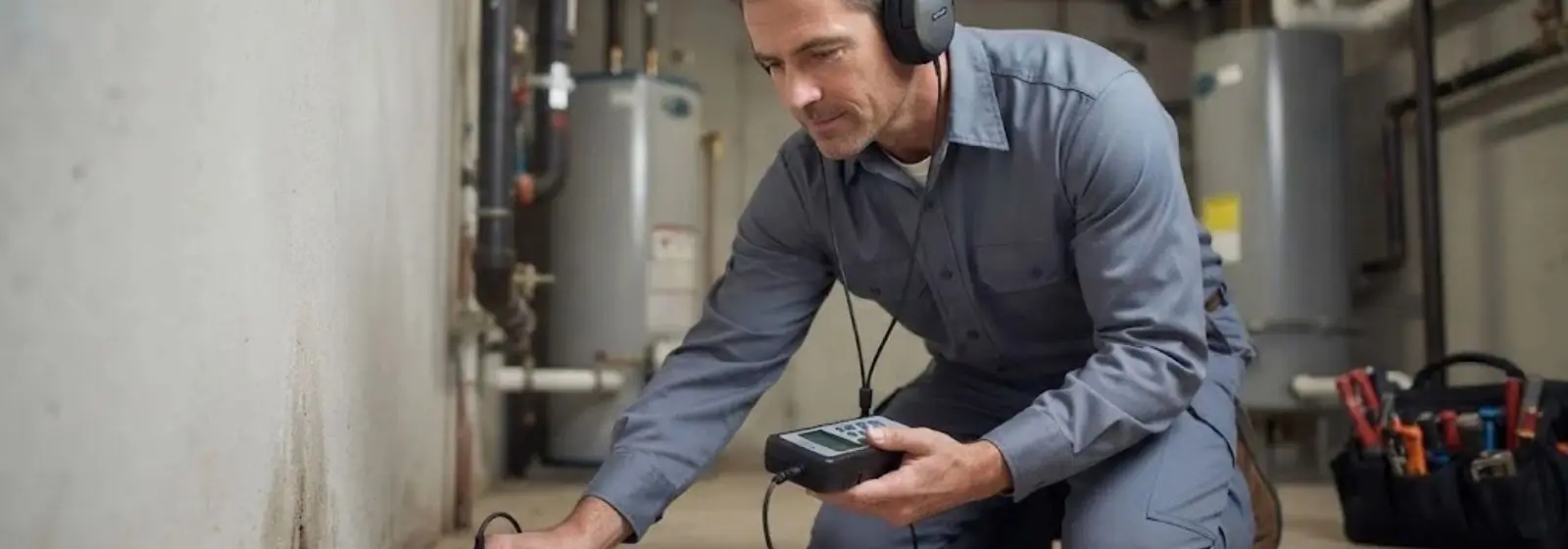
Emergency Leak Detection in Rahway, NJ
A warm floor, a stain that keeps growing or a water bill that makes no sense. We find where the water is going, explain it, and price the repair before anything is opened.
Water where it should not be: what to do first
Hidden water is an emergency even when it looks small, because it keeps soaking framing, insulation and flooring while you decide what to do. Our line is open 24/7. While you wait, close the main valve if water is actively flowing, stay away from wet outlets and appliances, and move anything valuable off the floor.
Leak detection means finding a leak you cannot see, using sound, heat, moisture and pressure instead of guesswork. For Rahway, NJ homes and buildings, the goal is a precise location so any wall, floor or yard opening stays small. We offer same-day appointments when the schedule allows, and calls that come in after hours get the same attention as any other.
Meter keeps moving
With every fixture off, the dial or low-flow indicator still turns. Water is escaping somewhere past the meter.
Bill jumps without a reason
Usage climbs for a month or two, but nothing changed in the household.
Warm or damp spot on the floor
A warm patch on a slab can mean a hot water line is leaking underneath.
Stains and bubbling paint
A ceiling ring that grows, paint that blisters or a musty corner in a wall.
Running water you cannot place
A hiss or trickle when the house is quiet and nothing is on.
Soggy strip of yard
A green, spongy or sunken line between the street and the house.
How a leak gets found, step by step
Listen to the story
We ask what you noticed and when, then check the meter, the main valve, visible piping, appliances and the stained area itself.
Isolate the system
We close sections one at a time to learn whether the loss is on the hot side, the cold side, the buried line or the drains.
Pinpoint the spot
Acoustic gear, thermal imaging, moisture meters, tracer gas or a pipe locator narrow the search, often to a few feet.
Confirm and quote
A pressure test or camera confirms the finding where possible. You get a plain explanation and a clear price for repair before work starts.
The tools behind the diagnosis
No single device finds every leak, so we match methods to pipe material, depth and floor covering and confirm one with another.
Acoustic listening devices
Ground microphones and contact sensors pick up the sound of pressurized water escaping a pipe. The sound is loudest over the leak. Plastic pipe carries sound poorly, so it needs extra care.
Thermal imaging
An infrared camera shows temperature differences on walls, floors and ceilings. It suits hot water lines and wet insulation, but it screens rather than proves.
Moisture meters
Pin and pad meters read moisture in drywall, wood and subfloor. They show how far water has spread.
Tracer gas
A tracer gas blend made for this work is pushed into an emptied line. It rises through soil and floor materials, and a sensor finds where it escapes. It helps when sound is faint.
Pipe locators
Electromagnetic locators trace a buried line, showing its path and rough depth before anyone digs.
Pressure testing and camera
Isolating a line and watching a gauge shows whether it holds pressure. A small camera inspects drains and accessible cavities where a leak may hide.
Water bill or stain you cannot explain?
Call the 24/7 line. We will tell you whether it sounds like a job for the meter test, a listening visit or an emergency shutoff.
High water bill or a meter that will not stop
A bill that climbs with no change in who lives in the home is the most common reason people call us about hidden leaks. A silent toilet leak or a slow supply leak can use far more water than a visible drip. A ten-minute meter test tells you whether water is leaving the house at all.
Stop all water use
Close every faucet, skip flushing, and pause the dishwasher, washer, ice maker and any irrigation.
Find the meter
It may sit in a box near the curb or on a basement wall. Lift the lid carefully and wipe the glass clear.
Watch the indicator
Most meters have a small dial or triangle that turns with even tiny flow. If it moves, write down the reading, wait an hour with no use and read it again.
Split house from line
Close the main valve inside the house and look again. If the meter still moves, the loss is between the meter and that valve. If it stops, the leak is inside.
Ask Veolia Water Rahway for your usage history so you can see when the climb began. Veolia customer service is 877-303-2435. A sharp rise that starts in one billing period often points to an event, such as a freeze, a new appliance or ground movement.
Ownership matters once you find wet ground. The city owns the line from the main to the curb stop, and the property owner owns it from the curb stop to the building. If water is rising on the street side of the curb stop, call Veolia Water Rahway before anyone digs. On your side, our water line repair service handles the fix.
A leaking toilet flapper, a stuck fill valve or a dripping outdoor spigot also moves the meter. We check these first.
Slab leaks: warm floors, noise and wet flooring
About 64.9 percent of Rahway homes were built before 1980 (Census ACS), so supply lines running in or under floors have had decades to wear. A slab leak is a leak in a pipe that runs in or beneath a concrete floor, and it rarely shows up as a puddle.
Watch for a warm spot underfoot, a water heater that seems to run constantly, the sound of water with all fixtures off, damp carpet or lifting laminate. Two or more together mean a real leak.
We first work out whether the leak is on a hot or cold line, then listen over the floor with a ground microphone and scan it with a thermal camera. A pipe locator and tracer gas confirm the path when sound is weak. You then choose between a spot repair through a small opening, rerouting the line overhead, or repiping that section.
Drain leaks under a floor behave differently because drain pipes are not under pressure. A camera and a fill test tell the two apart.
Ceiling and wall leaks: stains, bubbling paint and a musty smell
Water travels. A brown ring on a ceiling can sit several feet from the pipe that caused it, because water follows joists to the first low point.
Blistered paint, soft drywall, a musty smell and visible mold on a wall are all warning signs. A moisture meter maps the wet zone and a thermal camera shows its edges. We then test the supply and drain lines serving that area, because the source could be a pipe, a shower valve, a drain joint or even a roof or window. If it points outside plumbing, we say so.
Stay out from under a ceiling that bulges with water, and turn off power to that area at the panel only if you can reach it safely. Mold can start growing in a day or two in a wet cavity, so speed matters. We find and stop the water, and mold removal is a separate specialty.
Under the house: basement, crawlspace and floor-level leaks
Basements and crawlspaces give the easiest view of a house's plumbing, so many leaks are found there. Look for drips at joints, green crust on copper, rust on galvanized fittings and stains under the floor above.
We test the piping section by section, then use thermal imaging on the underside of floors and a moisture meter on joists and sill plates. Not every wet basement is a pipe leak. Rahway has flood-prone areas along the Rahway River branches, so water that shows up after rain may be groundwater, which is why we run a dry-weather meter test before blaming pipes.
When the evidence points to groundwater, the fix belongs with sump pump repair or, for recurring seepage, basement waterproofing.
Buried service lines and yard leaks
A leak on the service line outside the house can run for months before it shows. Signs include a spongy or unusually green strip of lawn, a sunken patch, water standing in the meter box, lower pressure than usual or a meter that moves with the house valve closed.
Water in the meter box can come from the meter fitting, the curb stop or a joint on either side. Because ownership changes at the curb stop, we identify which side the leak is on before anything is touched. A leak on the city side is a call to Veolia Water Rahway, and we do not dig there.
On your side, a pipe locator traces the line, a ground microphone listens along its path and tracer gas helps where soil muffles the sound. Call 811 at least three full business days before any digging, weekends and holidays excluded.
Buildings from before June 1986 may have lead or galvanized service lines. Ask the city engineering office whether yours is on its Water Quality Assurance Initiative inventory before paying for any replacement.
Irrigation, pool, spa and commercial properties
Irrigation systems
Sprinkler lines sit shallow and leak at valves, heads and fittings. A zone that never dries, a pooling spot or a meter that moves only when the system runs points to irrigation. We check the supply line and backflow device feeding the system, while heads and controllers are usually the irrigation contractor's work.
Pools and spas
Pools lose water to evaporation, so a bucket test comes first: set a bucket filled to pool level on a step and compare both levels a day later. If the pool drops faster, we pressure test the supply, return and fill lines. Shell and liner repairs go to pool specialists.
Commercial buildings
Restaurants, offices and multifamily buildings have many fixtures, long runs and several tenants. Rahway has many two-family and multifamily buildings, and one meter may serve several units, so we test unit by unit. Our commercial plumbing team can schedule work after hours so the space stays usable.
Match the symptom to the method
| What you notice | Where the leak likely is | How we confirm it |
|---|---|---|
| Meter moves with everything off | Anywhere past the meter: supply pipes, a fixture or the buried line | Meter test, valve isolation, then ground microphone |
| Warm spot on the floor | Hot supply line in or under a slab | Thermal imaging, ground microphone, pipe locator |
| Running water, nothing on | Supply line in a wall, floor or yard | Acoustic listening and pressure test |
| Ceiling stain that keeps growing | A supply or drain line above, a shower valve or a roof | Moisture meter, thermal imaging, line tests |
| Soggy or sunken strip of lawn | Buried service line on the owner's side | Pipe locator, tracer gas, ground microphone |
| Water in the meter box | Meter fitting, curb stop or a nearby joint | Visual check, ownership split, Veolia Water Rahway if on the city side |
| Damp basement floor only after rain | Groundwater, not a pipe | Dry-weather meter test and sump check |
What leak detection does and does not do
Detection finds the leak. It does not fix it. You get the location, a plain explanation of what is failing and your repair options, and the repair is a separate step with its own clear price.
It also does not restore finishes. Breaking a slab, patching drywall, painting and replacing flooring are separate trades, so ask what any quote includes. Because the pinpoint is accurate, the opening stays small, but no method is perfect, and in noisy or dense settings we may need two methods to agree before cutting.
Sometimes no pressurized pipe is leaking, and we say so. If the leak is a split line, our burst pipe repair service takes over. We do not handle mold removal, roofing or foundation repair.
Insurance, renters and sellers
Homeowner policies commonly cover sudden and accidental water damage but not gradual leaks or wear, so ask your insurer before repairs begin.
If you rent, tell your landlord in writing right away. About 48.5 percent of Rahway homes are renter-occupied (Census ACS), so the question of who arranges and pays for the search comes up often. Rahway also requires a Certificate of Approval for Continued Occupancy when a home sells or tenants change, and leaks found at that inspection can cause delays.
What affects the cost of leak detection
Want your real number? Call (732) 466-1098 and describe what you see. We also serve Clark, about 3 miles from our Rahway address, where 71.6 percent of homes were built before 1970 (Census ACS), so aging supply lines are just as common there. See our plumber in Clark page for that coverage.
Leak suspected right now?
The line is open 24/7. Close the main if water is flowing and call us.
Leak detection questions answered
Yes. The emergency line is open 24/7, including nights, weekends and holidays. If water is actively flowing, close your main valve and call, and we will tell you whether the search can start now or is better done at the next available same-day slot. We never promise a specific arrival time.
The clearest sign is a water meter that keeps moving when every fixture is off. Others are an unexplained jump in the bill, a warm patch on the floor, the sound of running water in a quiet house and stains that grow after the area has dried. A running toilet can mimic all of these, so we rule that out first.
Usually not to find it. Listening gear, thermal imaging and moisture meters work from the surface. Opening a wall or floor happens after the spot is narrowed down, and that opening is only large enough to reach the pipe.
It depends on where the leak is. The city owns the line from the main to the curb stop, and the property owner owns it from the curb stop to the building. If water is coming up on the street side of the curb stop, call Veolia Water Rahway. If it is on the building side, repair is the owner's job.
Policies differ, so ask your insurer. Many cover sudden and accidental water damage, but gradual leaks and wear are commonly excluded, and some policies treat the cost of finding a leak differently from the damage it caused. Get your answer before repairs begin and keep photos of everything.
Yes. Larger buildings usually need the search split by zone, floor or tenant space, and we can work after hours when the space is empty. Our commercial plumbing page explains how we approach those buildings.
We serve Rahway and nearby towns, including Clark, Linden, Roselle and the Colonia area of Woodbridge Township. Call with your address and we will confirm that we can get to you.