
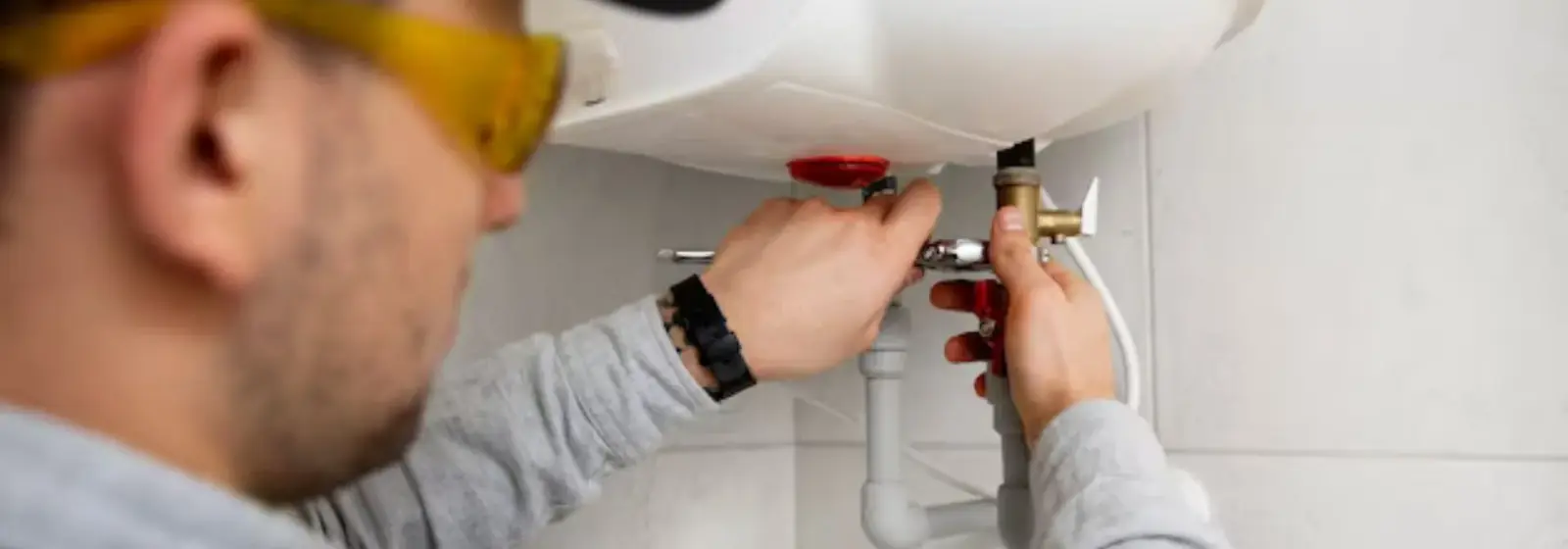
Emergency Water Heater Repair in Rahway, NJ
Leaking tank, cold showers or a heater that rumbles like a kettle? Call the 24/7 line and we will sort out repair or replacement with a clear price first.
Water heater trouble in Rahway: what to do first
A leaking or dead water heater is a same-day problem, and our 24/7 emergency line is open for it in Rahway, NJ. While you wait for us, close the cold water valve above the tank, switch off the breaker or turn a gas unit to pilot or off, and keep people away from standing water. If you smell gas, read the box below before anything else.
Water heater repair means finding the part that failed and fixing it while the tank itself is still sound. Most calls come down to a heating element, a thermostat, a thermocouple, a gas control, a valve or a fitting. When the tank is the failed part, we say so plainly, because that is a replacement job and not a repair.
Leave the building, leave the door open if you can do so safely, and do not touch light switches or use a phone inside. Call 911 and Elizabethtown Gas at 1-800-492-4009 from outside, since Elizabethtown Gas is the gas utility in Rahway. Call us after the area is cleared. We cannot give a response time on gas leaks, because the utility and the fire department come first.
Tank leaking or no hot water?
Call the 24/7 line at (732) 466-1098. Tell us the fuel, the age and where the water is coming from.
Where water heater leaks come from
Leaks are the biggest reason people call us, and the location of the water tells most of the story. Dry the tank and the floor with a towel, then watch for a few minutes with a flashlight. A leak from the top or side is often repairable, while a leak from the bottom of the jacket usually is not.
T&P valve and discharge pipe
The temperature and pressure relief valve opens when pressure or heat climbs too high. A steady drip from its pipe can mean a worn valve, but it can also mean high house pressure or a missing expansion tank. We test both before replacing the valve.
Drain valve
The valve near the bottom of the tank often seeps after a flush, especially the plastic ones. A new brass valve or a cap and washer usually ends it.
Supply and hot outlet fittings
Water at the nipples, unions or flexible connectors on top points to a fitting problem. These are typically fixed without touching the tank.
Element gasket (electric)
A seeping gasket around a heating element leaves a wet insulation patch behind the access panel. Replacing the element and gasket together is common.
Condensation
Cold water in a warm basement can sweat, and a hybrid unit makes real condensate. Both can mimic a leak, so we check the drain line before blaming the tank.
Tank body
Rust streaks, wet insulation under the jacket or water spreading from the base mean the inner steel has failed. No sealant fixes that.
Why is a leaking tank usually a replacement? The tank is a steel vessel with a glass lining, and once corrosion has opened a hole, the hole grows. A patch might hold for a day, and then the failure usually comes back worse. If that is your situation, we will walk you through water heater replacement options and tell you what can wait until morning.
One more cause is easy to miss. If the T&P valve drips only after the heater cycles, pressure may be spiking inside a closed system, because thermal expansion has nowhere to go. An expansion tank on the cold line absorbs that, and we check its air charge as part of the diagnosis. Replacing the valve alone just resets the clock.
No hot water, or not enough: the usual causes
Start with the fuel, because the failure list differs. We test with a multimeter on electric units and with a manometer and a flame check on gas, and we do not swap parts to see what happens.
Gas units
- Pilot out or a worn thermocouple that shuts the gas valve as the flame cools.
- A dirty burner or a clogged air inlet that gives a weak or yellow flame.
- A failed gas control valve or thermostat that reads the tank temperature wrong.
- A blocked flue or poor draft, which is a safety problem and not just a comfort one.
Electric units
- A tripped breaker or a high-limit reset button that has popped.
- A burned out upper or lower element, with the lower one the most common reason for short hot showers.
- A failed thermostat that stops calling for heat.
- Wiring or a loose connection, which we will check and flag for an electrician if the problem is in the circuit.
Not enough hot water has a few extra suspects. A broken dip tube lets cold supply mix into the top of the tank. A thick sediment bed takes up space and insulates the water from the burner. A mixing valve set too low, or a household that has simply grown, can also make a good heater feel weak.
If hot water runs out fast and the tank is more than ten years old, ask yourself whether repair is the right spend. A new element costs far less than a new tank, but a bad dip tube in a corroded tank is a different story. We lay out both paths before we start work.
Popping, rumbling and sediment
Water carries minerals, and heating pushes them out of solution. They fall to the bottom of the tank as sediment. On a gas heater the burner then boils water trapped under that layer, which makes the popping, and on an electric heater the lower element sits buried and burns out.
Rahway water hardness is not something we can quote, so test your tap or ask Veolia Water Rahway for its annual water quality report. Harder water builds sediment faster. A yearly flush through the drain valve is a simple habit for most tank owners, and we can do it during any visit.
The anode rod is the other part worth knowing. This sacrificial metal rod corrodes in place of the tank steel, and once it is used up the tank starts to rust. Checking and replacing a worn rod can extend the life of a tank that is otherwise healthy, but a rod that cannot be unscrewed or a tank that is already weeping is past that stage.
Gas, electric or hybrid: how repairs differ
Rahway is mostly a utility gas town, with about 70.8 percent of homes heating with gas and 18.8 percent with electricity, so both kinds of heater are common here. Older homes also mean older venting and older shutoff valves, and we plan for that on every call. Hybrid heat pump units are newer and carry their own parts.
| Type | Common repair calls | What we check first | Limits |
|---|---|---|---|
| Gas tank | Pilot, thermocouple, burner, gas control, T&P valve | Flame quality, draft at the flue, gas shutoff and connector | Gas leaks and utility-side gas work go to Elizabethtown Gas |
| Electric tank | Elements, thermostats, high-limit, gasket leaks | Power at the terminals, element resistance | New circuits and panel work go to an electrician |
| Hybrid heat pump | Condensate drain, air filter, fan, sensors, element backup | Airflow, drain line and error code | Sealed-system refrigerant work needs a specialist |
| Tankless | Error codes, scale, flame sensor, flow sensor | Water flow, vent and descale status | See our tankless water heater service page |
Cold water and a clock ticking?
The 24/7 emergency line is (732) 466-1098. Same-day appointments when available.
Flood-damaged water heaters
Rahway sits on the Rahway River, and the Union County hazard plan counts three special flood hazard areas in the city. Hurricane Ida in 2021 and Irene in 2011 both sent the river well above flood stage. A basement that took on water may have drowned the burner, the gas control or the electric controls on a water heater.
Do not relight a heater that sat in floodwater. Manufacturers generally call for replacing submerged gas controls and electrical components, and silt packed into a burner or a flue can be dangerous. Shut off the gas and the breaker, and call us. Your insurer may need photos of the unit before we remove it.
Basement water heaters and floor drains
Many Rahway homes were built before 1980, and the water heater usually lives in the basement near a floor drain. That layout helps when a tank leaks, because water has somewhere to go. It hurts when the drain is clogged, the trap is dry or a sump pit is already full, because then a small leak can flood the room.
If you can, put a battery-powered water alarm on the floor beside the heater. Pour a bucket of water into the nearby floor drain to see that it runs. The city's code treats sump pump water as a storm-system discharge, so ask the city engineer before choosing a place to send it, and see our sump pump repair page if the pit is part of the problem.
Repair or replace: a decision table
We do not push replacement, and we do not patch a tank that is clearly done. These are the rules of thumb we use at the heater.
| Situation | Usually repair | Usually replace |
|---|---|---|
| Water at T&P valve or fittings | Yes, once pressure and expansion are checked | Only if the tank is also corroded |
| Leak from tank body or bottom | Rarely | Yes, the steel has failed |
| No heat, tank under about 8 years | Element, thermostat or thermocouple | Not unless rust or sediment is severe |
| No heat, tank past about 12 years | Possible, but weigh the next failure | Often the better value |
| Popping noise, light sediment | Flush and anode check | Not needed yet |
| Hard-packed sediment, rusty water | Short-term only | Likely |
What affects the cost of a water heater repair
We give a clear price before work starts. Want your real number? Call (732) 466-1098 and describe the heater, and we will tell you what it is likely to involve.
Homeowner policies commonly cover a sudden tank failure that damages the house, but not gradual leaks or wear on the heater itself. Ask your insurer before you file, and keep photos of the unit and the water damage. If the leak has been slow, our leak detection team can help find where it started.
If your home is in Clark, our Clark plumber page covers that service area. If the system that failed is a boiler and not a tank, go to boiler repair.
Water heater repair questions
Yes. Our emergency line is open 24/7, and a leaking tank at 2 a.m. is exactly the kind of call it is for. We offer same-day appointments when available and cannot promise an arrival time, so tell us on the phone how much water is coming out and whether the tank has a gas line or a breaker you can switch off.
No. A dripping T&P valve, a loose fitting, a bad drain valve or a failed element gasket can be repaired. Water that comes from the tank body or the bottom of the jacket almost always means the steel has rusted through, and then replacement is the honest answer.
Sediment settles on the bottom of the tank, traps small pockets of water under it, and the burner or lower element boils those pockets. A flush can help in the early stages. A thick layer that has hardened is harder to remove and sometimes tells you the tank is near the end of its life.
Many people do, following the label on the heater. Stop if you smell gas, if the pilot will not stay lit after a couple of careful tries, or if the burner area looks sooty. Those signs point to a failing thermocouple, a gas control or a draft problem that needs a licensed plumber.
Check that the floor drain is clear before a leak starts, because a drain full of debris or a dry trap lets water spread. We can clear and test a drain during the visit. If the water is not draining at all, a drain cleaning call comes first.
Tank units commonly last 8 to 12 years, depending on water quality, how often the tank is flushed and whether the anode rod was ever checked. Age matters less than condition, so we look at corrosion, sediment and the repair history before recommending anything.
Do not turn it on. Gas controls and electrical parts that were submerged should be inspected or replaced before the unit runs again, and we would rather replace than gamble. Call us, and keep the power and gas off until someone qualified has looked at it.