
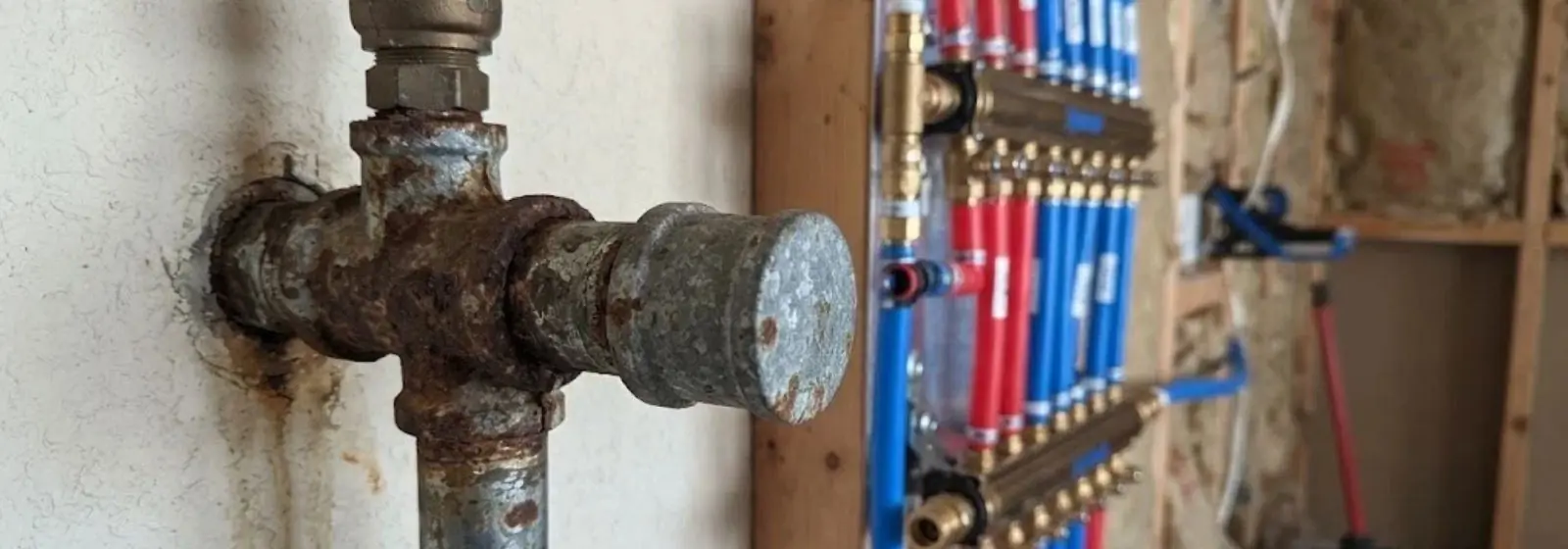
Repiping in Rahway, NJ
When old supply pipes keep leaking, clogging or turning your water brown, patching stops making sense. We assess the whole system, explain the materials and price the work before it starts.
Repiping in Rahway, NJ: what it is and when it makes sense
Repiping means replacing a building's water supply pipes with new pipe, either throughout the house or along a run that has failed. It does not usually include drain pipes, which carry waste away. In Rahway, NJ, repiping most often replaces old galvanized steel or aging copper.
A single pinhole leak can be patched. Repeated leaks, weak flow and brown water at several taps are a sign the pipe itself is the problem. That is the point where a repiping plan costs less than a string of repairs.
Why older Rahway homes are candidates
About 28.6 percent of Rahway homes were built before 1950, and 48.3 percent before 1960 (Census ACS). Galvanized steel was common in homes from that era, and many have since been partly updated, so one house may have three or four pipe types. A mixed system can fail at the joint where two metals meet.
That does not mean every older home needs repiping. A plumber should look at the actual pipe, test the pressure and flow, and tell you what the evidence shows. We assess first and recommend only what the pipe condition supports.
Signs you may need repiping
Rust-brown or cloudy water
Color that returns at several taps, especially after the water sits overnight, can point to corroding steel.
Falling water pressure
Mineral and rust buildup narrows galvanized pipe from the inside until flow drops.
Pinhole leaks
Tiny leaks in copper, often more than one in a few years, suggest pitting along the pipe.
Repeated repairs
If every fix is followed by a new leak nearby, the pipe is failing along its length.
Visible corrosion
Green crust on copper or orange scale on steel at joints and bends.
Noisy or banging lines
Loose or scaled pipes can rattle, but this has other causes too.
If you are not sure, a leak detection visit can tell whether you have a single failure or a pattern.
Not sure it is the pipes?
Call and describe what you see. We will tell you whether it sounds like a repair or a repiping question.
Copper, PEX or CPVC: honest trade-offs
Each material works. The right choice depends on your house, your budget, and your water.
| Material | Strengths | Trade-offs | Good fit when |
|---|---|---|---|
| Copper | Long track record, handles heat well, not affected by sunlight | More expensive, slower to install, can pit in some water | You want a traditional metal system or have exposed runs |
| PEX | Flexible, fewer joints, fast through walls and ceilings | Needs sunlight protection, not for some outdoor uses, fittings need care | Walls are finished and access is limited |
| CPVC | Lower cost, no corrosion | More rigid, can become brittle with age, sensitive to some chemicals | Straight runs where cost matters most |
| Galvanized steel | Familiar in old homes | Corrodes from inside, narrows over time, rarely chosen for new work | It is the problem, not the answer |
Look for NSF/ANSI 61 on potable components. We explain which material we recommend and why, and we give you the option to choose differently.
Whole house or partial repipe
A whole-house repipe replaces the supply piping from the entry point to every fixture. It makes sense when the pipe is the same age everywhere and failing in several places. It also makes sense when a home is being renovated and walls are already open.
A partial repipe replaces a run, such as the main trunk, a bathroom branch or a kitchen line. It costs less and disturbs less of the house. The trade-off is that older pipes elsewhere may fail later, so we say which sections are most at risk.
How we get to the pipes
Plumbers reach supply lines through the least destructive route. That often means basements, crawlspaces, attics and closets, with small access openings cut in drywall only where needed. New lines run through existing chases when possible. If a remodel is planned, it ties into plumbing installation work and the schedule of other trades.
Some walls must be opened. We explain where, how large the openings will be, and who handles patching, since drywall, plaster, tile and paint are different trades. Ask what is included in any quote.
Living at home during the work
Most repiping jobs allow you to stay home, but water will be off for part of each day. Plan for dust, noise and furniture moved away from walls. We discuss the sequence in advance so you can plan showers, laundry and cooking.
If you rent, tell your landlord first. About 48.5 percent of Rahway homes are renter-occupied (Census ACS), and the owner usually decides on repiping and holds the permit. Sellers should know that Rahway requires a Certificate of Approval for Continued Occupancy when a home sells or tenants change, and failed fixtures or leaks found at that inspection can complicate the timeline.
Permits, licensing and timeline
New Jersey requires plumbing work to be done by a licensed master plumber, an authorized plumbing contractor, or employees under a master plumber's supervision. You can verify a license through the Division of Consumer Affairs. Permit rules vary, so ask the Rahway Division of Building before work starts.
Timeline depends on house size, number of fixtures, access, material, inspections and how much finish work follows. Be wary of fixed promises made before anyone has seen the house. We give a plan with the scope and sequence and update you if conditions change.
Repiping versus repair
Repair may be enough
- One pinhole leak in sound pipe
- A failed fitting or valve
- A single frozen split, see burst pipe repair
- Low pressure caused by a regulator or valve
Think repiping
- Multiple leaks in a few years
- Brown water at several taps
- Galvanized pipe with falling pressure
- Plans to renovate and open walls anyway
Before committing, check pressure. A low-pressure problem might come from the street line rather than the house, which is covered on our water line repair page.
What affects the cost of repiping
Want your real number? Call (732) 466-1098 and we will walk through your house. We also serve Clark, where 71.6 percent of homes were built before 1970 (Census ACS), on our plumber in Clark page.
Ready to talk through a repipe?
Call the line and describe what is failing. We offer same-day assessments when the schedule allows.
New supply piping goes in under the National Standard Plumbing Code as adopted in New Jersey, and potable pipe and fittings should carry NSF/ANSI 61 marking. Ask us to show you the markings on what goes into your walls.
Repiping questions answered
Galvanized pipe is gray, sometimes with rust-brown stains and threaded joints. A magnet sticks to it, while copper and plastic do not. If your home was built before 1960, check an exposed run in the basement.
Neither is better in every home. Copper is durable and familiar but costs more and takes longer to install. PEX is flexible and often quicker through walls, but it must be protected from sunlight and some chemicals. We explain the fit for your house.
Usually not. Water is shut off during parts of each day, so you plan around that, and the work makes noise and dust. We discuss the sequence and water-off periods before starting.
It depends on the job, so ask what the quote includes. Many plumbers leave opened walls for a drywall or paint contractor. We state in advance whether patching is included, and we do not assume it is.
New Jersey requires plumbing work to be done by a licensed master plumber, an authorized plumbing contractor, or employees under a master plumber's supervision. Permit rules vary, so ask the Rahway Division of Building before work starts.
It varies with the size of the home, number of fixtures, access and whether it is a whole-house or partial job. We give a plan with the scope and sequence, but we do not promise a number of days.
Yes, if the rest of the system is sound. A partial repipe often targets a failing run, such as a kitchen branch or a basement main. We will say if the remaining pipes are close to the same age and likely to fail next.