
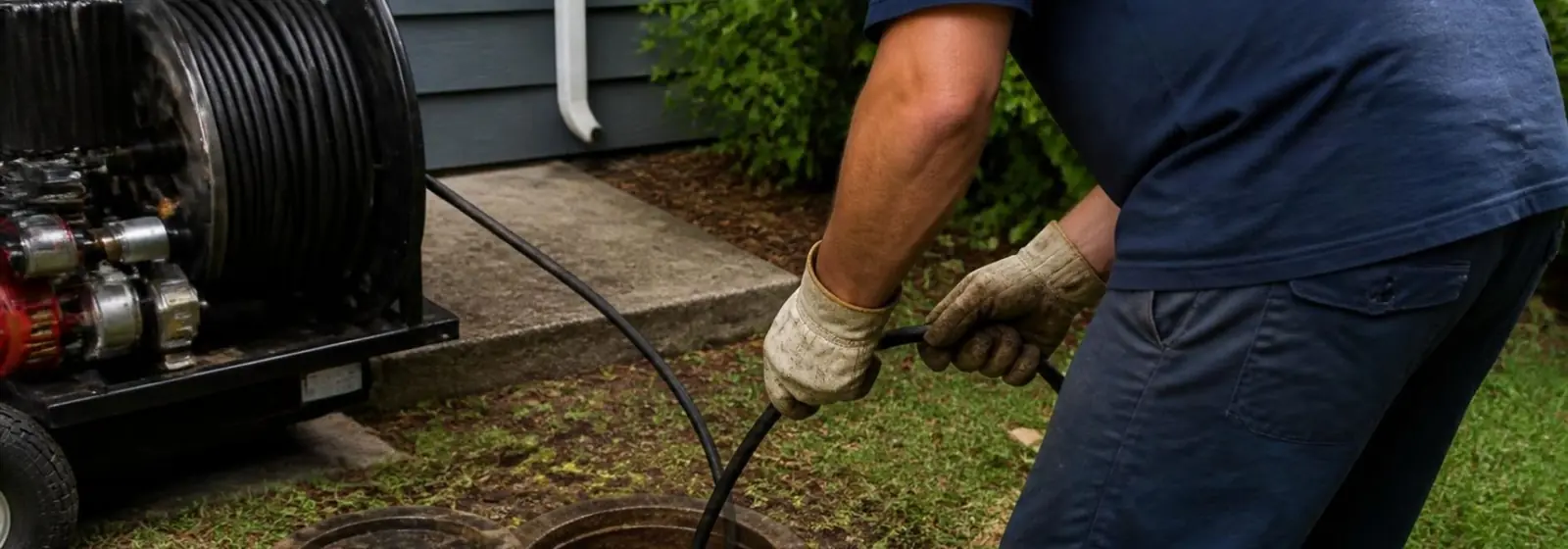
Emergency Sewer Line Cleaning in Rahway, NJ
Sewage in a floor drain or tub means the main line is blocked. We clear it from the cleanout, tell you what we found and explain how to keep it from coming back.
Sewer backup: what to do first
Sewage in the basement is an emergency, and our 24/7 line at (732) 466-1098 is the right number for sewer line cleaning in Rahway, NJ. Stop all water use in the house at once, since every flush and every load of laundry sends more into the pipe that is already full. Keep children, pets and anyone with a weak immune system away from the area.
Stop the water
Pause showers, toilets, the washer and the dishwasher. Tell everyone in the home.
Protect yourself
Avoid contact with the water. Wear rubber boots and gloves if you must enter, and wash well after.
Watch for electrical hazards
If water reaches outlets or appliances, stay out of it and call an electrician. We do not handle electrical work.
Call and wait
Call us, tell us which fixtures are affected, and do not open the cleanout cap alone.
They will not reach the blockage, they mix with sewage and they add a hazard for the person who opens the line. Wait for a plumber and the right equipment.
Signs the main line is blocked
The classic sign is the lowest fixture backing up first. A basement floor drain, shower or laundry tub is lower than the toilets upstairs, so sewage reaches it before anything else. If the floor drain gurgles or fills when you flush or run the washer, the main is the likely culprit.
Other signs include several drains going slow at once, toilets that bubble when another fixture drains and a sewage smell near the floor drain. One slow sink is a branch clog and a job for ordinary drain cleaning. When two or more fixtures show problems, it is the main line.
Sewage on the floor?
Call the 24/7 line now. We will tell you the price before work starts.
Finding and using your cleanout
A cleanout is a capped opening that gives a plumber direct access to the main line. Most homes have one outside near the foundation or inside on the main drain, often a few inches across with a square or round cap. It is where we feed the cable or the jetter into the line.
Know where yours is before you need it. If you can find it, you save a lot of time on an emergency call. Do not remove the cap on a full line without help, because the water behind it is under pressure and will come out fast. If the access is buried or missing, we can talk through options when we arrive.
- Look along the foundation wall near where the water service enters.
- Check the basement floor near the main stack for a capped fitting.
- Look for a round or square cap in a short length of exposed pipe outside.
- If the lid is stuck or buried, leave it alone and tell us when you call.
How tree roots clog a sewer line
Roots follow moisture. A small crack or a loose joint in an old clay or cast iron sewer lets moisture seep out, and fine roots grow toward it and in. Once inside, they thicken, catch paper and grease and form a plug. Roots are among the most common reasons a main line backs up repeatedly.
A cable with a root cutter clears the plug fast. Cutting does not close the crack, though, so the roots return, sometimes within a year or two. A camera shows where they enter, and a spot repair or sewer line repair stops the cycle.
Cable or jet on a main line
Both tools reach the main from the cleanout. A larger cable cuts roots and breaks through compacted debris. Hydro jetting cleans the full wall of the pipe and is the better tool for grease, scale and sludge that stay behind a cable.
| Situation | Tool we usually choose | Reason |
|---|---|---|
| First-time backup, plug suspected | Cable from the cleanout | Fast way to restore flow |
| Roots entering at joints | Root cutter cable, then camera | Cuts the plug and finds the entry |
| Heavy grease or scale | Hydro jetting after camera check | Scours the wall, not just the center |
| Backup returns within weeks | Jetting plus camera review | Cable has left the lining behind |
| Pipe cracked or collapsed | Camera first, then repair plan | Force can make damage worse |
After a backup: cleanup and insurance
Sewage in a basement contaminates porous materials such as carpet, drywall and cardboard. Hard floors can often be cleaned and disinfected, but soaked carpet and insulation usually come out. Do not run a household vacuum on sewage, and run fans only after you have talked to a cleanup professional. Our work stops at the plumbing, so we do not do water damage restoration.
Homeowner policies commonly exclude sewer and drain backup unless an endorsement was added, so check your policy before you assume. Take photos, keep receipts and call your insurer early. If your policy has the endorsement, ask what documentation they need. We can describe what we found and what we cleared in plain terms.
Who maintains what: RVSA, the city and you
Rahway is a sewered city, and sewage is treated by the Rahway Valley Sewerage Authority (RVSA), which has 11 member towns, including Rahway and Clark. RVSA handles treatment, not the pipe in your yard. The line from your house to the street is a separate matter.
Ask the Rahway city engineering office or public works about who maintains which section before you pay for work near the street. The city's code keeps clean water out of the sanitary sewer, so roof drains and sump discharge belong elsewhere. If neighbors on your street back up after heavy rain too, tell the city.
Heavy rain and basement drains
Not every floor drain backup is a clog. During heavy storms, a floor drain can fill because the municipal system is carrying more flow than usual, or because clean water is entering the sanitary sewer where it does not belong. If your line was cleaned recently and it still backs up only in storms, say so when you call.
That pattern points away from your pipe and toward a check valve, a sump discharge or the city system. Our sump pump repair team can look at the first two. Rahway sits near the Rahway River and has known flood areas, so ask the city engineer whether your property is in a flood hazard area.
Main sewer cleaning as maintenance
Cleaning a main line before it backs up is cheaper than cleaning it after a basement floods. Homes with large trees near the line, older clay or cast iron pipe, or a history of backups are the likeliest to benefit. Many of Rahway's older homes fit that description, since the median home was built in 1962.
The usual pattern is a camera look, a cleaning and then a follow-up date based on what we see. A line that is clean and tight may need nothing for years, while one with root entries may need yearly cleaning until it is repaired. Our sewer inspection page explains the camera step.
What affects the cost of sewer line cleaning
Want your real number? Call (732) 466-1098 for a clear price before work starts. We also serve Clark, Colonia and Linden, and we can describe options when the cleaning shows the pipe itself is failing.
Sewer line cleaning questions
Yes. We answer (732) 466-1098 24/7, and sewage in the house cannot wait for office hours. We take your details, tell you how to limit the damage and schedule a plumber as soon as one is free, though we do not promise an arrival time.
It is a capped pipe, usually near the foundation outside or on the main drain in the basement or crawlspace, often close to where the main leaves the house. If you cannot find it, tell us on the phone. Do not open the cap on a backed-up line without help because pressure behind it can push water out.
Often it does not. Many homeowner policies exclude sewer and drain backup unless you added an endorsement. Check your policy, call your insurer early and take photos before cleanup. We cannot tell you what your policy covers.
It depends on which section. The pipe inside your property is yours, but ownership beyond that is not something we can state for you. Ask the Rahway city engineering office or public works about who maintains which section before you pay for work near the street.
If buildup or roots caused it, cleaning clears the line and may hold for a good while. If the pipe is cracked, offset or bellied, the problem will return. A camera look after cleaning tells us which one you have.
No. A clogged toilet affects one fixture. A sewer backup affects several, often the lowest ones first, such as a basement floor drain or shower. If more than one fixture is affected, treat it as a main line problem and call.