
Emergency Hydro Jetting in Rahway, NJ
When a cable only buys you a few weeks, high pressure water cleans the pipe wall itself. Our licensed plumbers jet drain and sewer lines and check the result with a camera.
Repeat backup tonight? Read this first
If a line has backed up again and a cable only bought you a few days, call our 24/7 line for hydro jetting in Rahway, NJ at (732) 466-1098. Hydro jetting means cleaning a pipe with a hose and a nozzle that fires high pressure water against the walls. Stop using the affected drains while you wait, keep water off the floor and do not add chemical cleaner.
Standing sewage is a health hazard, so keep children and pets out of the room and wear boots and gloves if you have to walk through it. Turn off the washer and dishwasher at the machine rather than letting them run. We would rather talk you through these steps than have you guess.
How a hydro jetter actually works
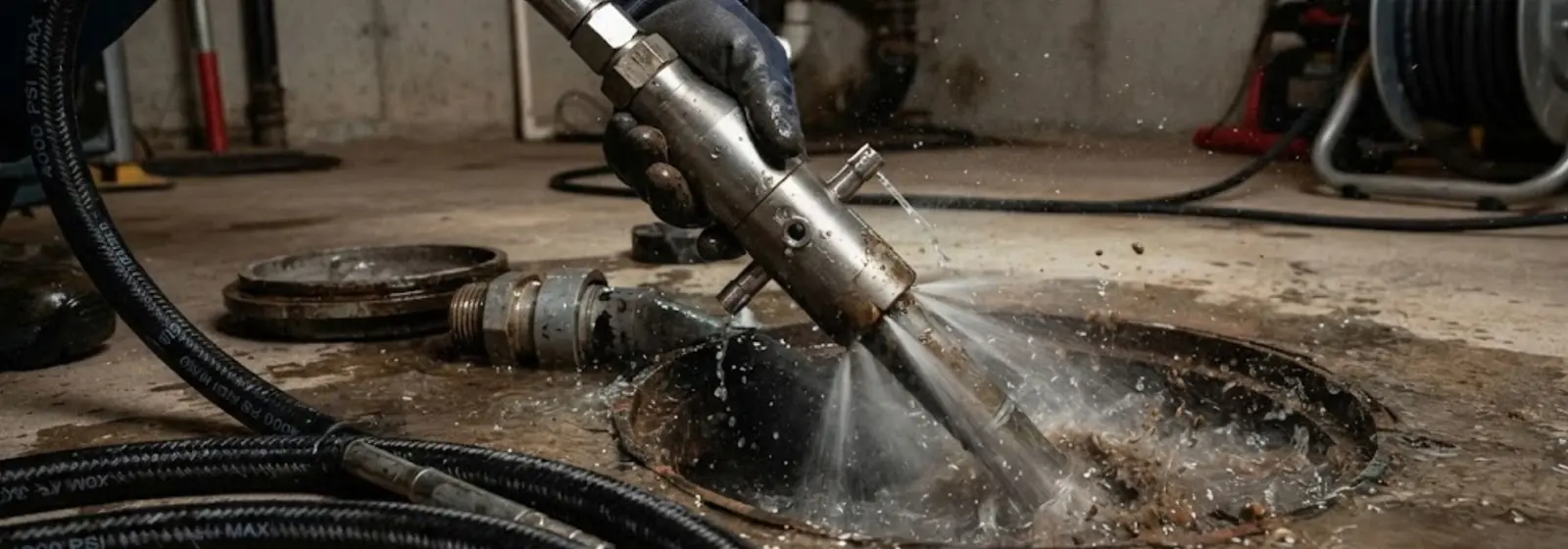
A jetter pumps water through a flexible hose to a steel nozzle. The nozzle has jets pointing backward, which pull it along the pipe, and others that spray sideways to scour the wall. Some nozzles also have a forward jet to break up a plug. The water and debris flow out toward the cleanout, drain or sewer.
We feed the hose in through a cleanout or an opened trap, and work from the far end back so the debris travels the shortest distance. Pressure matters, but so does flow and nozzle choice. A small residential nozzle on a kitchen branch is very different from a larger one on a main line.
What hydro jetting removes
Grease and fat
The white or yellow lining that builds in kitchen lines and holds every scrap that follows.
Mineral scale
Hard crust inside older pipe that narrows the opening and catches paper.
Roots
Fine hair roots and the mat that forms around them. Large roots may need cutting first.
Soap and sludge
Soft layers that coat the walls of laundry, bath and kitchen branch lines.
Loose debris
Sand, silt and small solids that settle in low spots and grow into a plug.
Paper and wipes
Snagged material wrapped around rough joints and offsets.
Why a cable can get stuck or leave the pipe coated
A cable bores a hole through a blockage. It works well when the blockage is a plug, but if the pipe wall is coated with grease or scale, the hole closes again as more material builds against the rough surface. This is why some clogs return every few weeks.
A cable can also hang up. Its head can catch on an offset joint, a root mass or a cracked section, and in the worst case it can jam or snap inside the pipe. A jetter has no cable to stick, but it also needs the pipe to be sound, which is why the camera matters. If you have had the same drain cleared by cable three times this year, jetting is worth discussing.
Same drain, third time?
Call the 24/7 line and tell us what has been tried. We will help you pick the right tool.
Cable versus jet at a glance
| Drain cable | Hydro jetter | |
|---|---|---|
| How it works | Rotating steel cable with a cutting or hook head | High pressure water from a rotating nozzle |
| Suits | Single plugs, hair, paper, a quick fix | Grease, scale, sludge and clogs that keep returning |
| Leaves behind | A channel, with the wall coating often untouched | A cleaned wall, with debris flushed out |
| Risk | Can snag, gouge brittle pipe or snap | Can damage cracked, flaking or collapsed pipe |
| Needs a camera first? | Sometimes, for old or unknown pipe | Often, to confirm the pipe can take it |
| Access needed | Trap, cleanout or vent | A cleanout or an open end the hose can enter |
When we do not jet: camera first
High pressure water can finish off a pipe that is already failing. Cracked cast iron, flaking old clay, offset joints and some mid-century fiber or bituminous lines are all poor candidates until we know their condition. A collapsed pipe cannot be jetted at all.
When the history is unclear, we run a camera first, which is what our sewer camera inspection does. If the camera shows weak pipe, we change the plan to a gentle cable, a liner or a repair. We would rather tell you no to jetting than make a small problem into a dig.
Restaurants, apartment buildings and two-family houses
Rahway has many two-family homes and small multifamily buildings, and these share one building drain. A single kitchen line serving two apartments clogs faster than a line serving one household. Restaurants add grease at volume, so their lines coat quickly. Our commercial plumbing team handles those buildings, and grease traps and interceptors need their own attention too.
For landlords, repeat backups cost more than a scheduled cleaning. A jetting visit after a camera look can tell you whether the line needs cleaning only or a repair. Tenants should report slow drains early, before the line fills.
Signs a line is coated and due for jetting
Drains slow again within weeks
Each cable run helps briefly and then the same symptom returns.
Kitchen line smells of old grease
A sour smell comes from the film on the pipe wall, not from the trap.
Gurgling that comes and goes
Air passes a narrowed section of pipe on its way to the vent.
Multiple fixtures sluggish at once
A coated main or branch restricts every fixture that feeds it.
A preventive schedule that fits your building
The idea is to clean on a schedule before a backup forces your hand. Kitchen-heavy lines in restaurants might be cleaned several times a year, while a home with a root history might be cleaned once a year and checked with a camera. A quiet household line may only need it when symptoms show up.
We set the interval after we see how fast buildup returns, not from a chart. After the first jetting, we run a camera, note the pipe's condition and suggest a date for the next visit. If you add a heavy grease user, such as a catering operation in the building, tell us so the interval changes.
After the jet: the camera check
Run the camera through
We feed a small camera down the same line to see the walls, joints and any low spots.
Compare to the before
If we looked first, we compare what has changed. If not, we note the condition for your records.
Look for causes
Roots, offsets, cracks and bellies show where the next blockage will start.
Talk through what is next
You hear what was cleaned, what we saw and whether cleaning is enough or a repair makes sense.
If the camera shows damage, our drain cleaning and repair services have the next step. For lasting root problems, see our sewer line cleaning page.
What affects the cost of hydro jetting
Want your real number? Call (732) 466-1098 for a clear price before work starts. Homeowner policies commonly exclude backup and wear-related damage unless you added an endorsement, so ask your insurer before you rely on coverage. We also work in Clark and nearby towns.
Hydro jetting questions
Yes. The line at (732) 466-1098 stays open 24/7. If a kitchen line or main has backed up overnight, call and we will schedule jetting the same day when the schedule allows. We will not promise an arrival time, but we do ask a few questions up front so the right equipment is on the truck.
Not always. Strong pipe in good shape handles it well, but cracked, flaking or collapsed pipe can be damaged. That is why we look first with a camera when a line is old or the history is unclear. If the camera shows weak pipe, we recommend a different tool or a repair.
A cable pushes through a blockage and leaves a channel. A jetter sends high pressure water out of a nozzle that scours the whole inside wall. The cable is quicker for a simple clog and the jet is the better tool for grease, scale and clogs that keep returning.
It can clear roots inside the pipe, especially fine hair roots, and the water scours the wall behind them. Roots grow back if the entry point stays open, though. A camera shows where they get in, and a sewer line repair may be the lasting fix.
There is no single interval. Kitchen lines with heavy grease may need cleaning several times a year, while a quiet residential line may need it once in several years. We usually set a schedule after a camera look shows how fast buildup returns.
If the cause is buildup or roots inside the pipe, it often does for a good while. If the cause is a belly, a broken joint or a collapse, jetting only clears the symptom. We check afterward with a camera so we can tell you which case you have.