
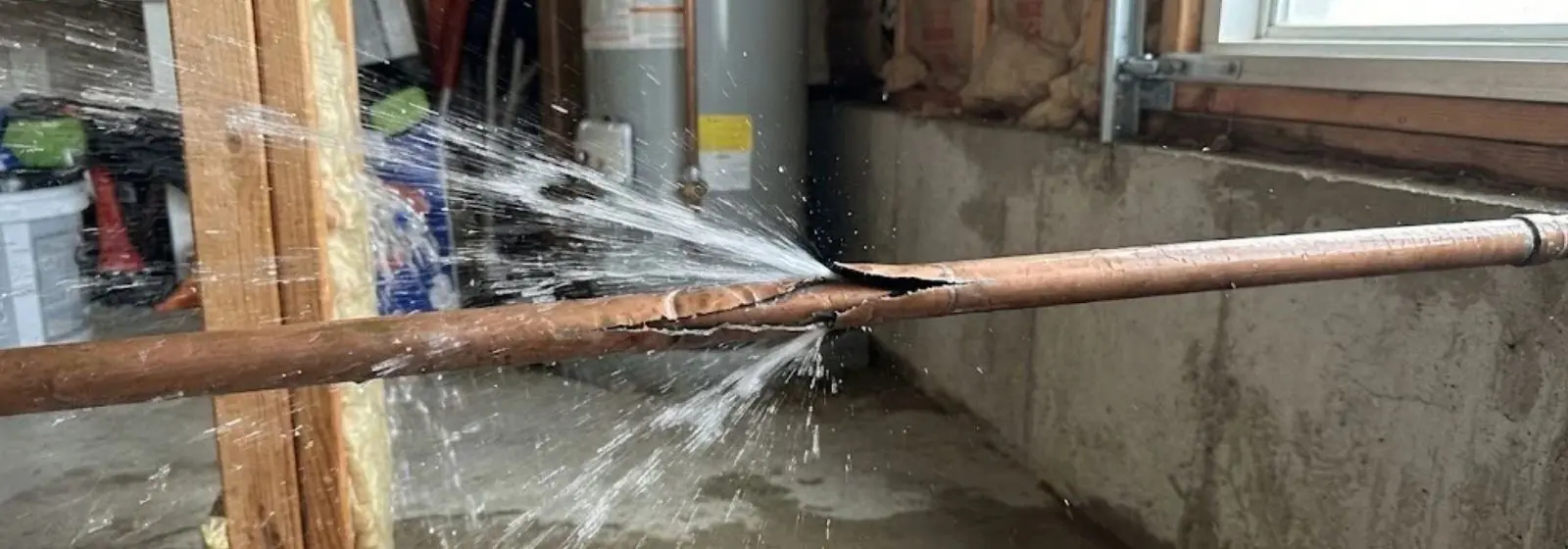
Emergency Burst Pipe Repair in Rahway, NJ
Water is moving and every minute adds damage. Shut the main, keep clear of electricity and call us. We stop the flow, repair the split and tell you plainly what else is at risk.
Pipe burst? Shut it off before anything else
A split supply pipe can release gallons every minute, and the water reaches ceilings, wiring and floors quickly. Our 24/7 emergency line is open, but the most valuable thing you can do is close the main valve before you call. Then keep everyone away from standing water near outlets.
Emergency burst pipe repair in Rahway, NJ starts with stopping the flow, then finding the failure and replacing the damaged section. The repair is usually fast once the water is off. The damage control around it is where the hours go.
Close the main valve
Turn the handle where the line enters the building, usually near the meter. A lever closes with a quarter turn, a wheel turns clockwise.
Drain the lines
Open the lowest cold faucet in the house, then upper ones, and flush toilets once. This releases pressure and empties the system of water that would otherwise keep running out.
Protect the water heater
Once the main is shut, turn the electric breaker for the heater off or set a gas heater to pilot. That keeps it from heating an empty tank.
Call and document
Phone us, then photograph the pipe, the water and the damage before you start cleanup.
Water and electricity: what to stay away from
Water that reaches outlets, appliances or the panel is a shock hazard. Do not wade through standing water to reach the breaker panel. If the panel is dry and you can reach it without stepping in water, switch off the breakers for the wet areas. If not, leave it and tell us when you call.
If a ceiling is sagging with trapped water, stay out from underneath it. Do not turn on lights in a room where water is dripping through the fixture. If you smell gas, leave the building, call 911 and Elizabethtown Gas at 1-800-492-4009 from outside, and call us afterward.
Water still running?
Close the main and call the 24/7 line. Same-day appointments are available when the schedule allows.
Frozen pipes: why they split and how to thaw them safely
Water expands as it freezes, but the pipe usually does not split where the ice sits. Pressure builds between the ice blockage and a closed faucet, and the weakest point gives way. The split often stays hidden until the ice melts and water flows again.
In Union County homes the usual freeze points are pipes in exterior walls, runs in unheated basements and garages, lines near the rim of the foundation and outdoor hose bibs. Rahway's housing is older, with a median build year of 1962 (Census ACS), so pipes in older exterior walls may have little protection from the cold.
If a pipe is frozen but not split
Open the nearest faucet so melting water can escape. Warm the pipe slowly with a hair dryer, a heating pad or warm towels, working from the faucet back toward the frozen section. Never use a torch, a propane heater or any open flame. Open flame near framing turns a plumbing problem into a fire.
If you see a crack, bulge or water
Shut off the main, open the faucets and call. Do not thaw a pipe that has already split, because thawing it releases the flow. Once repaired, restore water slowly and check every joint for drips.
Safe to do yourself
- Open the faucet nearest the frozen area
- Warm the pipe with a hair dryer or heating pad
- Let cabinet doors stay open to warm pipes
- Disconnect hoses and shut off interior hose bib valves
- Keep the heat on during a cold snap
Call us instead
- Any visible crack, bulge or leak
- Frozen lines inside a wall or floor you cannot reach
- Pipes that refreeze after thawing
- Frozen boiler or heating pipes
- Water coming through a ceiling or wall
Cracked and broken pipes by material
How a pipe fails tells us how to fix it. Rahway has many older buildings, with 28.6 percent of homes built before 1950 (Census ACS), so we see a mix of old and new materials, sometimes in the same house.
| Pipe material | How it usually fails | Typical repair | Honest note |
|---|---|---|---|
| Copper | Splits along the seam when frozen, pinhole pitting from inside, joint failures | Cut out the section and install new copper with a coupling or press fittings | One repair is fine, repeated pinholes suggest the whole run is aging |
| PEX | Fitting failures, damage from nails or screws, UV exposure | Cut out and join with a PEX coupling, fitting or press connection | Flexes with freezing better than rigid pipe, but fittings can still crack |
| Galvanized steel | Corrodes from inside, leaks at threads, narrows and loses pressure | Replace the failed section or the run | A repair often reveals the next weak spot nearby |
| CPVC | Becomes brittle with age, cracks at fittings | Cut and replace with a compatible fitting | Check that fittings match the pipe system |
| Cast iron drain | Cracks, rusted joints, collapse at bends | Cut and replace with couplings or new drain pipe | Damage is often hidden behind walls or under floors |
Repair methods: from a coupling to a partial repipe
The right repair depends on the pipe, where it failed and how much of the run is sound. We show you the damaged pipe and explain the options before work starts.
- Cut-out and replace: the damaged piece is removed and a new section joins the sound pipe on each side. This is the standard fix for a single split.
- Couplings: compression, slip or push-to-connect couplings join new pipe to old without soldering. Some are meant for permanent repair, some for temporary use, so we say which is which.
- Press fittings: a tool crimps a fitting onto the pipe with no open flame, which helps in tight or flammable spaces.
- Partial repipe: when several sections are failing, replacing a whole run can beat repeated emergency calls. See our repiping page for that process.
Drain pipe repair follows similar logic but has different materials and slope requirements. A cracked drain stack or a broken lateral is cut out and replaced, and a camera shows how far the damage goes.
After the water stops: water damage first steps
Water damage grows for days after the pipe is fixed. Moving fast limits what has to be torn out.
- Photograph or video the pipe, the standing water and each affected room before cleanup.
- Move furniture, rugs and electronics out of the wet area.
- Remove standing water with a wet vacuum or towels if the area is safe from electricity.
- Open windows and run fans or a dehumidifier to dry the area.
- Keep wet materials you remove until your insurer has seen them or approved disposal.
- Do not use ceiling fixtures, outlets or appliances that got wet until they are checked.
We repair the pipe and can tell you what the failure damaged. Drywall, flooring, mold removal and water extraction are separate trades. Ask any contractor what is included before you agree.
Insurance, tenants and sellers
Homeowner policies commonly cover sudden and accidental pipe bursts and the damage they cause. Gradual leaks, wear and damage from neglect, such as freezing in a home left without heat, may not be covered. Policies differ, so call your insurer early and ask before you start repairs.
About 48.5 percent of Rahway homes are renter-occupied (Census ACS), so tenants should tell the landlord in writing and keep copies. Rahway also requires a Certificate of Approval for Continued Occupancy when a home sells or tenants change, and unrepaired water damage can complicate that inspection.
While you wait for us
Main valve closed
Confirm the meter is no longer moving. If it still is, tell us on the phone.
Faucets open
Keep the lowest faucets open until water stops draining.
Power secured
Stay out of wet rooms with outlets or appliances.
Photos taken
Capture the damage before cleanup for your insurer.
Clear access
Move items away from the pipe, shutoff and water heater.
Pets and people clear
Keep children and animals out of the wet area.
Why hidden bursts need a leak search
Not every burst is visible. A split in a wall or under a floor can soak a cavity for hours before a stain appears. When the damage does not match the visible pipe, we use leak detection gear to find the source. If the failure is on the buried line between the street and the house, the repair becomes water line repair.
What affects the cost of burst pipe repair
Want your real number? Call (732) 466-1098 and describe what you see. We serve Clark as well, about 3 miles from our Rahway address, and our plumber in Clark page explains that coverage.
Burst pipe flooding now?
Shut the main valve, then call. The line is open 24/7.
Burst pipe questions answered
Yes. Pipes can split at 3 a.m. as easily as at noon, so the line stays open 24/7. Close the main valve, call, and we will tell you what to do while we arrange the earliest visit our schedule allows. We do not promise arrival times.
Look where the water line enters the building, usually in a basement, utility room or garage, close to the meter. A lever handle turned a quarter turn closes a ball valve, and a round wheel handle turns clockwise. Find it before you ever need it and tag it.
Often yes, if the pipe has not split. Open the faucet, warm the pipe slowly with a hair dryer or heating pad starting nearest the faucet, and never use an open flame. If you see a crack, a bulge or water, shut the main and call instead.
Policies commonly cover sudden bursts and the resulting water damage, but may not cover gradual leaks or damage from neglect, such as freezing in a home left unheated. Policies differ, so call your insurer early and ask. Photograph everything before cleanup.
No. Many bursts are one split in one section, repaired by cutting out the damaged piece and installing new pipe. When several sections are failing, a partial repipe can cost less over time than repeated emergency repairs, and we explain that choice with prices.
Drain bursts and cracks are different because the pipe carries wastewater and is not under pressure. Stop using fixtures on that line and call. For a failing main sewer line, see our sewer line repair page.
Call your landlord or property manager right away and keep records of when you told them. If it is an active flood, shutting the main and calling a plumber is reasonable while you wait. Tell the landlord what was done.