
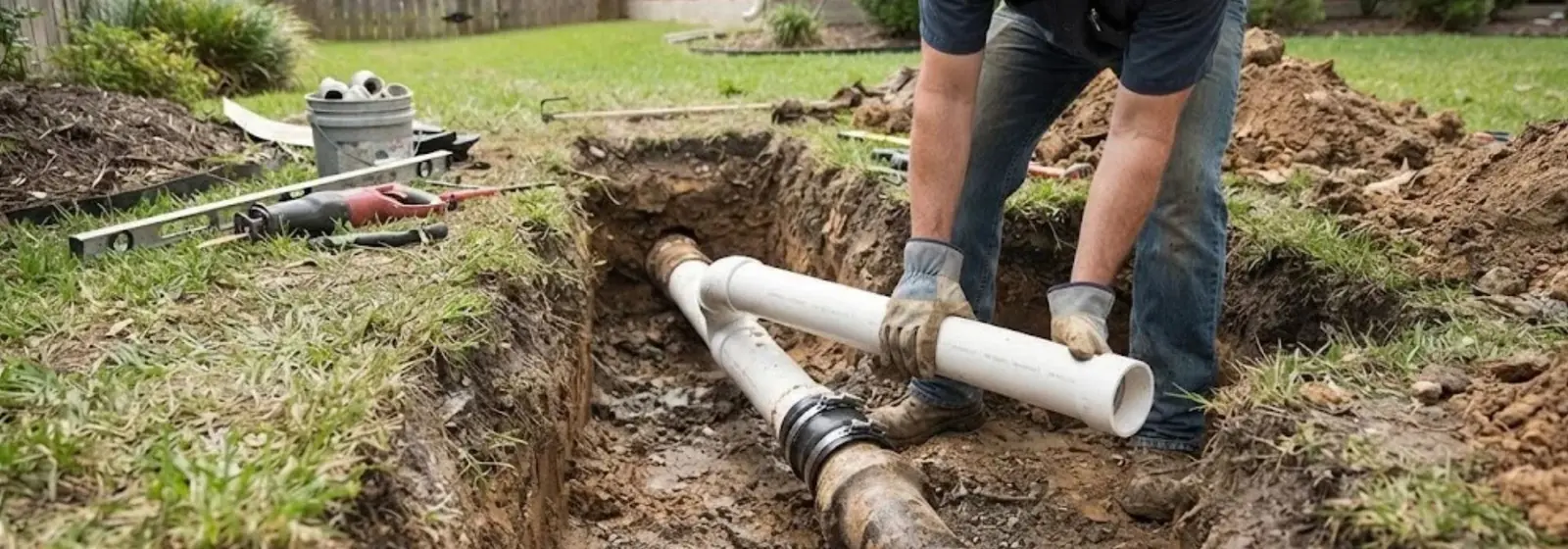
Emergency Sewer Line Repair in Rahway, NJ
When cleaning only clears the symptom, the pipe itself has failed. We confirm the problem on camera, explain spot repair, lining and replacement honestly, and give you the price before the dig.
Sewer line failing: what to do while you wait
A failed sewer line shows up as sewage in the lowest drains, a smell in the yard or a sinkhole-like dip in the lawn. For emergency sewer line repair in Rahway, NJ call (732) 466-1098 any hour, since the line is open 24/7. Stop water use now, because anything you drain goes into a pipe that is broken or blocked.
Stop all water use
No flushing, showers or laundry. Tell everyone in the home. Fill a few jugs with water for essentials.
Keep people away
Sewage carries bacteria. Keep children, pets and food out of the room and use gloves and boots to cross it.
Do not pour chemicals
Cleaners will not fix a broken pipe and they add a hazard for the crew.
Document the damage
Take photos before cleanup. Your insurer may ask for them.
Our first visit may be cleaning, not repair. Restoring flow stops the damage, and a camera run then tells us whether the pipe needs work. A repair plan made without seeing the pipe is a guess.
Sewage backing up?
Call the 24/7 line. We start by getting the line flowing and then show you what failed.
Signs your sewer line is failing
Repeat backups
The line clears with a cable and backs up again within weeks or months.
Sewage smell in the yard
Odor near the foundation or lawn can mean a leak or break in the line.
Soggy or sunken patch of lawn
A leaking line can wet the soil and, over time, make it settle.
Slow drains all over the house
A main line that is bellied or partly collapsed restricts every fixture.
Roots in the cleanout
Root fragments on the cable point to a crack or open joint.
Rodents or insects from the drains
Broken pipe can give pests a path into the house.
What your sewer pipe is probably made of
The median home in Rahway was built in 1962, and 48.3 percent of the city's homes date before 1960. In houses of that age, sewer laterals are commonly cast iron, vitrified clay or, in some mid-century construction, bituminous fiber pipe known as Orangeburg. Newer repairs and additions are usually PVC. A camera tells us what you have, because materials vary even on one street.
Each material fails in its own way. Cast iron rusts and flakes, clay cracks and shifts at the joints, Orangeburg can soften and flatten, and PVC can crack or pull apart if it was poorly bedded. Knowing the material shapes the options, since lining and spot repair work better on some than others.
Spot repair, lining or full replacement
The right fix is the smallest one that solves the problem for good. A short break in a long, healthy pipe is a spot repair candidate. A long run of cracked or leaking pipe may suit a liner or replacement.
| Option | Suits when | Trade-offs |
|---|---|---|
| Spot repair | One or two damaged sections in sound pipe, such as a cracked PVC length or a broken clay joint | Needs a dig at each spot. Does nothing for weak pipe elsewhere on the line |
| Trenchless pipe lining | Cracks, leaking joints and root entry in pipe that still holds its shape | Needs a clean pipe. Cannot fix a collapse or a belly. Slightly reduces the bore |
| Full lateral replacement | Collapsed, badly offset or heavily deteriorated pipe over a long run | Most disruptive and most lasting. Involves excavation, backfill and surface restoration |
Lining is not magic and it is not always the right answer. It depends on a clean, intact pipe, and a belly that holds water stays a belly. Digging is more disruptive but lets us fix the slope, replace the whole run with new pipe and remove the cause. We tell you which suits your line after the camera, and we do not recommend either by default.
Root intrusion: cut it, line it or replace it
Roots enter at joints and cracks, so cutting them clears the line but leaves the opening. If the pipe is otherwise sound, repeated sewer line cleaning on a schedule can keep you running for a time. When roots return every year, a spot repair or a liner that seals the joints is the better investment.
In older clay lines with many joints, roots may enter at several places. In that case, replacement may cost less over time than annual cleaning. A camera run lets us count the entry points, which is how you can compare the choices honestly.
Cracked PVC and newer pipe
PVC is tough but not immune. Poor bedding, settling soil, a heavy load over the line or a damaged coupling can crack or separate it. Because PVC sections are modular, a spot repair is often straightforward. We cut out the bad length, fit new pipe with couplings, check the slope and backfill with proper bedding.
The usual trouble with PVC is not the pipe but what is under it. A sag in the bedding lets the pipe settle into a belly, and a belly holds waste. If the camera shows that, a short repair with new bedding and the right slope is the fix, and cleaning alone will not hold. Our hydro jetting service can clear the buildup first so the camera sees the whole pipe.
Sewer lateral replacement
The lateral is the pipe between your house and the connection at the main. Replacing it means pulling out or abandoning the old pipe and laying new PVC at a steady slope. It is a bigger job than a spot repair, and it is the one that most reliably ends repeat problems on a failing line.
Ownership matters here. Ask the Rahway city engineering office or public works which sections the city maintains and which you do. Rahway is a sewered city, and the sewage ends up at the Rahway Valley Sewerage Authority, but who owns each stretch of pipe is a local question we cannot answer for you.
What a sewer line dig involves
Camera and locate
We confirm the problem on camera and mark the line and depth on the surface.
Call 811 and arrange permits
New Jersey requires a call to 811 at least three full business days before digging. Permit rules vary, so ask the Rahway Division of Building before work starts.
Excavate and replace
We open the ground, remove the failed pipe, bed and lay the new run at the correct slope.
Test, backfill and restore
We run water and camera checks, backfill in layers and leave the surface ready for finish work.
Restoration has limits you should know before the dig starts. Backfill and compaction are part of our work. Lawn, pavers, concrete, asphalt and landscaping are often separate trades, so confirm what is in the price before work starts. A trench through a driveway or sidewalk needs a plan for the finish surface.
Honest limits on what we do
We repair and replace sewer pipe, but we do not repair the municipal main in the street, and we do not handle structural foundation work or electrical. If your lateral connects to a city main, the connection itself may involve the city. Ask the Rahway city engineering office or public works before assuming who does what.
We also do not promise that a repair ends every backup. A new lateral cannot fix a clogged branch inside the house or a grease problem in a kitchen line. After the dig, we run water and a camera through the new pipe so you can see it work, then talk about cleaning needs for the rest of the system.
What affects the cost of sewer line repair
Want your real number? Call (732) 466-1098 for a clear price before work starts. Homeowner policies commonly cover sudden damage but not gradual wear, roots or backup unless an endorsement was added, so ask your insurer. We also serve Clark and nearby towns.
If your problem turns out to be a blockage rather than a break, our drain cleaning service may be all you need, and a sewer camera inspection shows which. If the water line is the issue instead, see water line repair.
Replacement piping and cleanouts follow the National Standard Plumbing Code as adopted in New Jersey. That is one reason a sewer repair is a job for a licensed plumber and not a quick patch.
Sewer line repair questions
Yes. The line at (732) 466-1098 is open 24/7. If sewage is backing up, we start with cleaning to restore flow and stop the damage, then plan the repair after a camera look. We do not promise an arrival time, but same-day appointments are available when the schedule allows.
Cleaning fixes a blockage. Repair fixes the pipe. If cleaning holds for months, the pipe may be fine. If the line backs up again within weeks, or the camera shows a crack, belly or collapse, a repair is the lasting answer.
Orangeburg is a bituminous fiber pipe that was used for house sewers in some mid-century construction. It can soften, flatten or delaminate with age. Not every older home has it. A camera inspection tells you what material your line is made of and what shape it is in.
It depends on the pipe. A liner works when the existing pipe is mostly intact and the problem is cracks or leaking joints. A collapsed section, a deep belly or a badly offset joint usually needs excavation. We explain the trade-offs after the camera run.
Whoever is digging must call 811 at least three full business days before digging, not counting weekends or holidays. We handle the call for work we perform. If you plan any digging yourself, call too.
Permit rules vary, so ask the Rahway Division of Building before work starts. Ordinary maintenance such as clearing a stoppage is treated differently from replacing pipe. We tell you what to ask and help you with the paperwork we handle.