
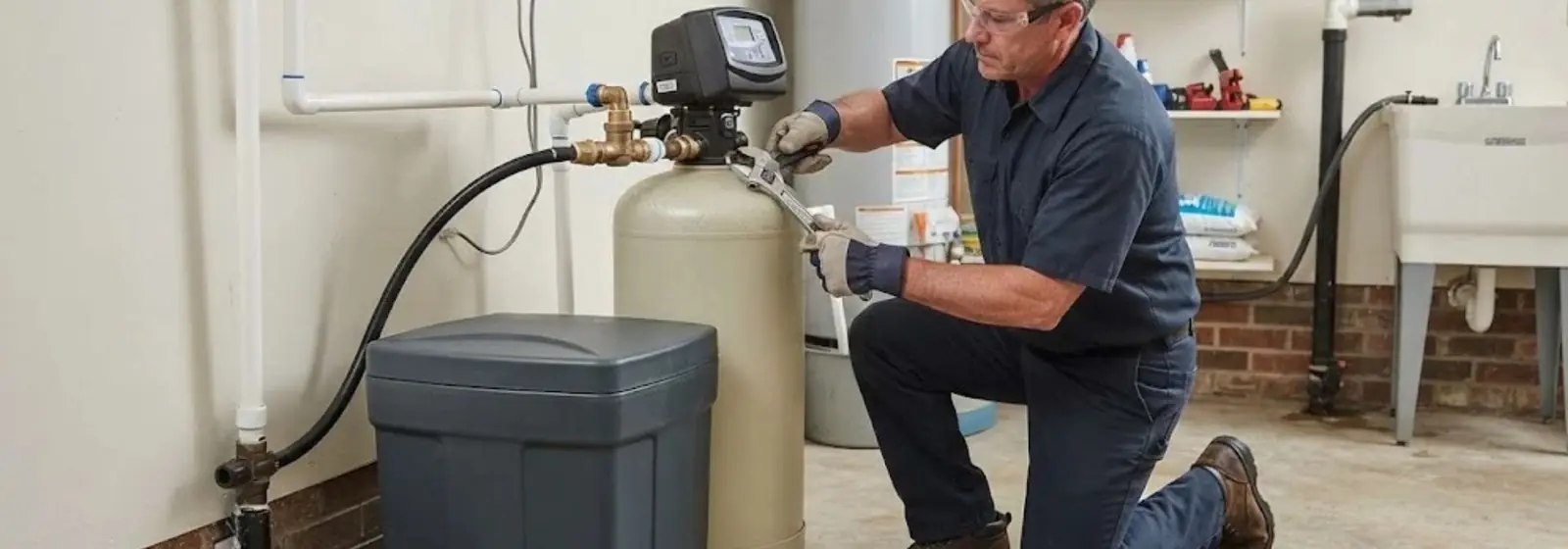
Where Water Softeners Are Installed in Rahway, NJ Homes
Where the softener, bypass, drain and brine tank go, and what to check before you buy.
Where a water softener goes in a house
Where water softeners are installed in Rahway, NJ homes is almost always the same spot: on the main cold water line, just after the main shutoff valve and the water meter, and before the water heater. That order means every hot and cold fixture inside gets softened water, while the softener itself sits within reach of a drain and an outlet. Most of the time that spot is a basement, utility room or garage.
A softener is a tank of resin beads plus a second tank that holds salt brine. Hard water passes through the resin, which trades the minerals for sodium or potassium. Every so often the unit flushes itself with brine and sends the wastewater down a drain line.
The plumbing layout, from the main inward
Main shutoff and meter first
The softener branches off after both. You want a working shutoff upstream so the whole house can be isolated for the install and for later service.
Bypass valve
A three-valve bypass or a built-in bypass lets you route water around the softener. It is what keeps the house running if the unit is being serviced or fails.
Softener before the water heater
Softened water feeds the heater and the rest of the house. Putting it before the heater protects the heater from scale and keeps hot water softened too.
Unsoftened takeoffs
Outdoor spigots and often one kitchen cold tap are tee-ed off ahead of the softener so lawns and drinking water are not softened.
If your basement already has copper or old galvanized on the main, a plumbing installation visit can include the tie-in fittings, shutoffs and a bypass in one trip. Plan for the line near the softener to be cut and reconnected.
Basement or garage: choosing the spot
| Factor | Basement | Garage |
|---|---|---|
| Distance to main | Usually close, short pipe runs | Can be far from the main, longer runs |
| Freezing risk | Low in most heated basements | Higher in an unheated garage, so check before choosing |
| Drain access | Floor drain, laundry standpipe or sump nearby | May have no floor drain, which limits options |
| Power | Outlet near the heater is common | Outlet may be on a shared circuit |
| Flood exposure | Consider height if the basement takes water | Often higher and drier |
| Salt hauling | Stairs can make bags harder | Easy loading from a vehicle |
Brine tank, drain line and air gap
The brine tank needs a flat, level spot with room to open the lid and load salt. Most homeowners underestimate how much floor space the pair takes up, so measure before buying. The control head also needs an outlet within reach of its cord.
The regeneration cycle produces wastewater, and that water has to go somewhere. The drain line runs to a floor drain, laundry standpipe or utility sink, and it must end above the drain opening with an air gap so dirty water cannot siphon back. Ask about the discharge point before the unit is chosen, because a basement with no nearby drain may need a condensate-style pump.
If your basement has a sump pit, do not just point the softener drain into it. The city's code keeps clean water out of the sanitary sewer, and sump discharge goes to the storm system or an approved outlet, so ask the city engineer how a softener drain should be handled.
Planning a softener install?
Call the line. We will look at your main, drain options and outlet before you buy the unit.
What to plan before the day
Know your water
Test your tap or ask Veolia Water Rahway for its annual water quality report. Hardness for Rahway is not something we state, because it is not verified in our sources.
Measure the space
Check the footprint of both tanks, the height of the control head, and the walk to the nearest drain.
Clear the main
Move storage away from the shutoff, meter and water heater so the pipe work is reachable.
Find your outlet
Look for a grounded outlet within cord length, ideally not on a circuit that trips when the dryer runs.
Pick the salt plan
Decide where bags will be stored and who loads the tank, so the unit does not run dry.
Cost factors without the guesswork
To compare quotes, make sure each one names the unit size, the bypass, the drain arrangement and whether the old fittings are being replaced. Call (732) 466-1098 for your real number.
What this means in Rahway
Rahway's tap water comes from a city-owned system run by Veolia (Veolia Water Rahway), with supply from the Rahway River and water bought from Middlesex Water Company at times. In winter 2025 road salt pushed chloride in the river up and the taste of tap water changed. Hardness is not verified in our sources, so test your tap or ask Veolia for its annual water quality report before you size a unit.
About half of Rahway homes (48.5 percent) are rentals, so a tenant who wants a softener should ask the landlord first. New Jersey also requires softener installation to be done by a licensed master plumber, an authorized plumbing contractor or employees working under a master plumber. You can verify any plumber through the Division of Consumer Affairs.
Softener and related plumbing work
Leaks around the softener tie-in are common after a poor install, and a damp floor is the early sign. If you notice moisture, our leak detection service finds the source before a slow drip becomes a stained slab. Homes in Clark and nearby towns have similar layouts, and we cover those too under our service areas.
Softener installation questions
Before. Softened water then feeds the heater and every fixture on the hot side, and it also helps keep scale out of the tank. The line to the water heater branches from the softened side.
Usually not. We tee off the spigot line ahead of the softener so lawn and garden use does not burn through salt. Many homeowners also leave one cold kitchen tap unsoftened for drinking.
We do not state hardness for Rahway because it is not verified in our sources. Test your tap with a kit or ask Veolia Water Rahway for its annual water quality report, then decide.
State rules say water softener installation is plumbing work, which must be done by a licensed master plumber, an authorized contractor or employees under a master plumber. A homeowner buying the unit can still choose the model, but the connection needs a licensed plumber.
To a floor drain, laundry standpipe or utility sink, with an air gap above the drain. Do not assume the sump pit is fine. Ask the city engineer before choosing a discharge point.
We look at a pump-assisted discharge or a different install spot. Your location in the house changes cost, so describe the layout when you call.