Tank to Tankless Water Heater Conversion in Rahway, NJ
A tankless switch is a conversion, not a swap. Here is what changes in the gas line, the vent, the flow and the upkeep.
Can you switch from a tank to a tankless heater?
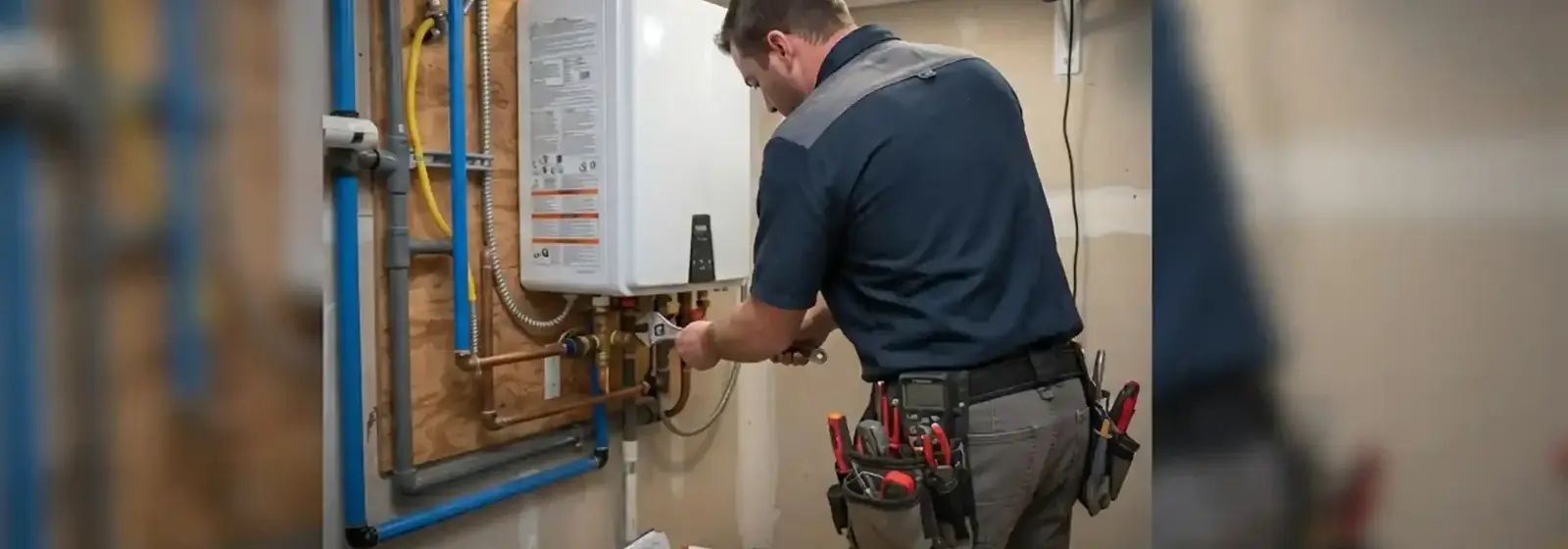
Yes, in most Rahway, NJ homes you can switch from a tank to a tankless water heater. But it is a conversion, not a like-for-like swap. The gas line, the vent and the water flow all need to be checked before anyone orders a unit.
A tankless heater fires hard for short bursts, so it pulls far more gas than a tank does while it runs. That is why the details matter more than the brand. Our tankless water heater service covers installs, conversions and descaling, and we explain what we find before work begins.
Tank versus tankless at a glance
| Item | Tank heater | Tankless heater |
|---|---|---|
| Hot water supply | Limited by tank size | Limited by flow rate |
| Gas demand | Lower, steady | Higher while firing |
| Venting | Often draws from a flue | Usually needs new vent materials |
| Space | Floor space for the tank | Wall mounted, smaller footprint |
| Scale sensitivity | Sediment collects in the tank | Scale builds in the heat exchanger |
| Conversion scope | Simple swap if same fuel | Gas, vent and drain changes likely |
The right column is not a verdict. It is a list of things to check at your house before deciding.
Gas line upsizing: the part people miss
Gas pipe is sized by the total load it carries and the length of the run. A pipe that fed a tank heater and a furnace may be too small once a tankless unit is added. We calculate the load, and if the pipe is short on capacity, we upsize the run.
The meter belongs to the utility. If your meter might be too small for the added load, Elizabethtown Gas is the one to ask. If you ever smell gas, leave the building, call 911 and the utility from outside, and call us afterward.
Venting and the condensate drain
Many tankless units use sealed vent pipe that runs out through a wall. Condensing models also produce acidic condensate that needs a drain, often with a neutralizer. A gravity flue that served the old tank may not be reusable.
Where the vent exits matters for clearances and for the neighbors. That is one more reason a site visit comes before a quote. Our water heater installation team plans the vent path first.
Planning a conversion?
Describe your current tank and where it sits. We will tell you what the switch involves.
Flow rates: sizing for how you live
Tankless ratings are in gallons per minute at a given temperature rise. Rise is the gap between your incoming water and the setting you want. Colder winter water means a bigger rise, so a unit that handles two showers in July may struggle in January.
- List every fixture that might run at once, like two showers and the dishwasher.
- Note the longest pipe run from the heater to the farthest bathroom.
- Consider a recirculation line if waiting for hot water bothers you.
- Ask the installer to size for winter, not summer.
Scale and why hardness matters
Hard water leaves mineral scale on hot surfaces. Inside a tankless unit that scale coats the heat exchanger, so the unit works harder and wears sooner. Hardness for Rahway is not something we can state, so test your tap with a kit or ask Veolia Water Rahway for its annual water quality report.
If your result is high, plan for a regular flush and maybe a water softener. If your result is low, you still want a maintenance schedule. Either way, ask the installer to include isolation valves so flushing is easy.
What changes the price of a conversion
Every house is different, so call (732) 466-1098 for your real number. We explain the price before work starts.
Is tankless right for your household?
Tankless heaters suit some homes better than others. A household that uses hot water in short, spread-out bursts often does well. A house with three bathrooms in use at once at the same hour needs a larger unit or a second one.
- Count your bathrooms and how often they run together.
- Check where the current heater sits and whether a wall nearby can take the unit.
- Look at your gas pipe size and where it enters the basement.
- Think about how long you plan to stay in the house.
We lay out the trade-offs before you buy. Sometimes the honest answer is that a new tank is the simpler choice, and we will say so.
What this means in Rahway
Census data shows utility gas heats 70.8 percent of Rahway homes, electricity 18.8 percent and fuel oil 6.4 percent. Gas is common, which makes a gas tankless conversion a frequent question. But heating fuel is not water heater fuel, so confirm your own setup at the unit.
The median Rahway home was built in 1962. Older homes often have gas pipe sized for older appliances, which is why we check the line before we pitch a unit. Water quality is the other open question, and Veolia Water Rahway can share its annual report.
We also install in Clark, where water comes from NJ American Water, so ask that utility for its report. See the areas we serve for nearby towns.
Questions about going tankless
Census data shows utility gas heats 70.8 percent of Rahway homes, so gas is common here. That says nothing about your own pipe size or meter, so we check those on site. Heating fuel also does not tell you what fuels your water heater.
It heats water as it flows, so it does not run out the way a tank can. It does have a flow limit, and running several showers and a dishwasher at once can exceed it. Sizing to your fixtures is the key step.
Yes, mineral scale can build up inside the heat exchanger and cut performance. We cannot state Rahway tap hardness because it is not verified. Test your tap or ask Veolia Water Rahway for its annual water quality report.
Often, but electric tankless units draw a lot of power at once. Your panel and circuit must support it, and that is an electrician's decision. We handle the plumbing connections.
Permit rules vary. Water heaters are not on the state ordinary maintenance list, so ask the Rahway Division of Building whether a permit applies. The work itself must be done by a licensed master plumber or a contractor working under one.
Most need periodic flushing to clear scale, and how often depends on your water. Ask your installer for a schedule that fits your tap results.