
Basement Waterproofing Process in Rahway, NJ, Step by Step
From diagnosing the water source to testing the sump, in the order a plumber would do it.
The basement waterproofing process, start to finish
Basement waterproofing in Rahway, NJ is a sequence of steps, not one product. First we find where the water comes from, then fix outside conditions like grading and gutters, then add inside drainage and a sump if water still shows up. Sealing and humidity control come last.
A plumbing company handles the drain channel, the sump pit and the pump. Structural foundation repair, such as moving wall cracks or bowed walls, is a different trade. We will tell you honestly which one your basement needs.
Step 1: find where the water comes from
The same wet floor can come from very different problems. Water can seep up through the slab, enter at the joint where wall meets floor, leak through a wall crack, drip from a failed pipe, or condense on cold surfaces. Treating the wrong source wastes money.
Seepage at the wall-floor joint
Dampness that rings the room after rain points to groundwater pressure.
Wall cracks
A wet line on a wall crack after storms. Moving cracks go to a structural contractor first.
Pipe leaks
Wet spots that appear on dry days. Our leak detection work rules this in or out.
Condensation
Damp air on cold pipes and walls in summer, with no water entering from outside.
A simple test helps. Tape a square of plastic sheet to the wall and floor and check it after a few days. Moisture under the plastic means water is coming through the concrete, while moisture on the outside of the plastic means it is condensation from room air.
Step 2: grading, gutters and downspouts
Before any inside work, look outside. Soil should slope away from the foundation, gutters should be clear, and downspouts should discharge several feet from the wall. These fixes cost little compared with interior drainage and can reduce the amount of water the basement sees.
Downspouts that dump next to the foundation are a very common cause. Extend them with a solid pipe that carries water well past the wall. Do not connect a downspout to the sanitary sewer, because the city's code keeps clean water out of it.
Basement taking on water now?
Call the 24/7 line. We can look at the drain and pump while you work on the outside.
Step 3: interior drain channel
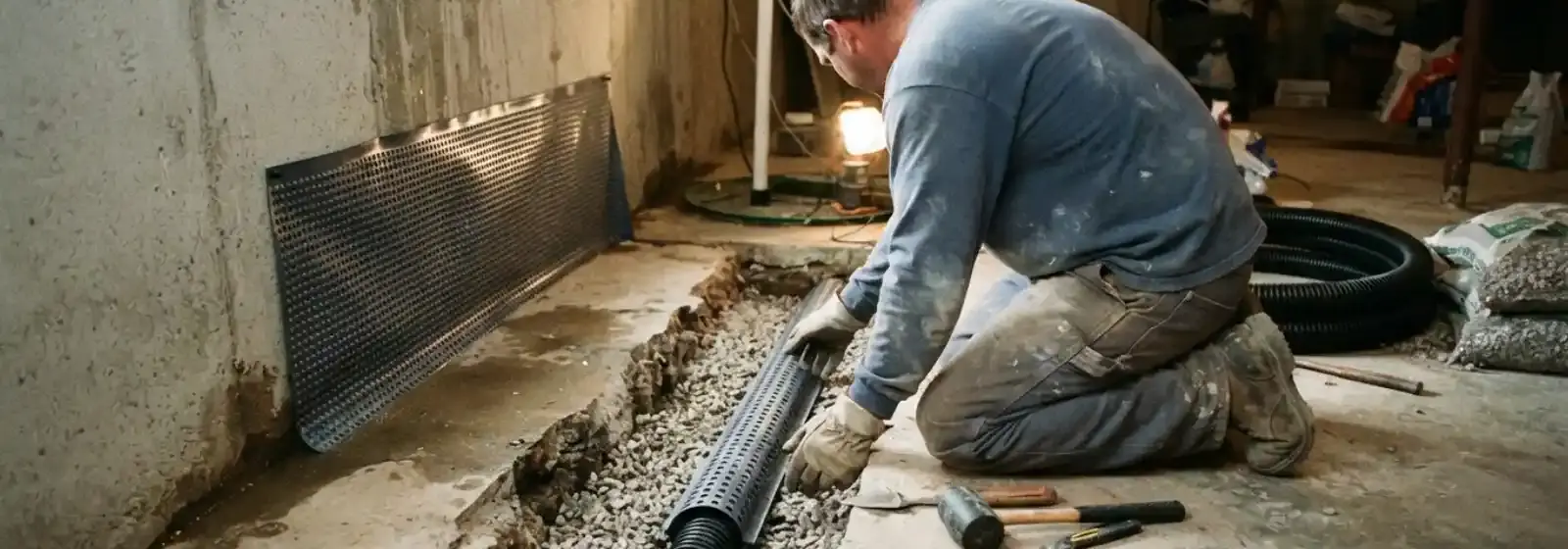
If water still gets in, the next layer is an interior drain. A channel is cut along the inside of the footing, a perforated pipe goes in a bed of stone, and the floor is patched with concrete. Water that reaches the footing flows into the channel instead of across the floor.
The channel leads to a sump pit, and the pit should be set so the water level in the soil can fall below the slab. This is the core of what our basement waterproofing service covers. The pipe slope, cleanouts and stone bed matter as much as the pipe itself.
Step 4: sump pit and pump
A sump pit collects water from the channel, and a pump moves it out through a discharge line with a check valve. Pit depth, liner, lid and float switch all matter. The switch is the part that fails most often, which is why many homes pair the primary pump with a battery backup.
Where the discharge goes needs care. The city's code keeps clean water out of the sanitary sewer, and sump pump water belongs in the storm system or an outlet the city engineer approves, so ask the city engineer before choosing a discharge point. If your pump is old, noisy or running constantly, our sump pump repair crew can test it before the next storm.
Steps 5 to 7: sealing, dehumidifier and testing
| Stage | What it does | What to expect |
|---|---|---|
| Sealing | Hydraulic cement or coatings close small cracks and the cove joint | Helps with damp walls, does not stop heavy water under pressure |
| Dehumidifier | Lowers humidity so mold and musty smell do not return | Needs its own drain line or regular emptying |
| Testing | Pour water into the channel, trip the float, run the pump | Confirms flow, discharge and alarm before storm season |
| Retest | Check after the first heavy rain | Shows whether grading and gutters are working |
Sealing is the part many homeowners try first, and it is also the part that fails first when water pressure is high. Paint-on coatings are not a substitute for drainage. Think of sealing as a finishing step on a basement that already has a way to shed water.
Cost factors and how to compare bids
Ask each bidder for the same scope in writing: footage of drain, pit depth, pump model, battery backup, discharge route and who restores the floor. Want your real number? Call (732) 466-1098.
What this means in Rahway
The Rahway River gauge at Rahway recorded its highest peak in August 2011 during Hurricane Irene at 12.10 feet, then 11.48 feet in September 2021 from Ida's remnants. The Union County hazard plan counts three special flood hazard areas in Rahway, the Rahway River, Robinson's Branch and the South Branch. If your basement is near one of them, expect river storms to test your pump, so a battery backup and a check valve are worth discussing.
The city engineer can say whether a property is in a flood hazard area. Rahway takes part in the National Flood Insurance Program, and NFIP policies have a 30-day waiting period, so do not wait for a storm forecast to ask about coverage. A basement that floods from a rising river is a different problem from seepage, and no drain system replaces flood insurance.
Homes in Clark, where Pumpkin Patch Brook and the Rahway River drive flood losses, face their own risks. See our service areas for towns we cover.
Where plumbing ends and structural work begins
We install drains, pits, pumps and discharge piping. We do not do structural foundation repair, such as underpinning, wall bracing or pier work, and a plumbing company should not pretend to. If cracks are widening or a wall bows inward, get a structural opinion first, then bring us in for the drainage.
Homeowner policies commonly cover sudden water events but not groundwater seepage or gradual damage, so ask your insurer what applies. In a flood zone, flood insurance is separate from a homeowner policy.
What to do while water is in the basement
Stay out of standing water if outlets, the panel or appliances are near it, and call an electrician or the utility if the panel is wet. Move valuables up and take photos for your insurer before cleanup. Do not run a vacuum or dehumidifier in standing water, and call us for the pump, drain or plumbing side of the problem.
Basement waterproofing questions
Check grading, gutters and downspouts first, and find out whether the water is seepage, a leak or condensation. Those checks cost little and can change the scope entirely.
No, do not assume that. The city's code keeps clean water out of the sanitary sewer, and sump pump water belongs in the storm system or an outlet the city engineer approves. Ask the city engineer before choosing a discharge point.
The city engineer can tell you whether a property is in a flood hazard area. Rahway has three special flood hazard areas in the Union County hazard plan, so check before buying coverage or planning a finished basement.
Not always. We handle drains, sump systems and discharge piping. Structural foundation repair is a separate trade, and we will say so if your basement needs one.
NFIP policies have a 30-day waiting period, so a policy bought during a storm warning will not help for that storm. Talk to your insurance agent well ahead of the season.
Often yes. A dry basement can still be humid in summer, and a dehumidifier with a drain line keeps the air from feeling damp. It is a finishing step, not a fix for water entry.